
Digital transformation
A Digital Leap for Small and Medium-Sized Enterprises
A practical SME digital transformation guide: four benefits, five steps, obstacles and the historical Viber chatbot example with evidence limitations.
Read articleExplore our articles
Strategy, processes and people. Change that delivers business results.
A practical SME digital transformation guide: four benefits, five steps, obstacles and the historical Viber chatbot example with evidence limitations.
Read article
Digital transformation does not usually fail because companies lack ideas. More often, it fails because they have too many disconnected ideas, poor sequencing, unclear ownership and unrealistic expectations from technology.
Read article
Many companies still approach digital transformation through one question: which software should we buy? That is the wrong starting point. Software can be an important part of the solution, but it does not change the way a company works by itself.
Read article
Digital transformation often starts with a good intention, but in practice it can quickly become another layer of complexity.
Read article
Digital transformation usually does not fail because a company has no ideas. It fails because there are too many ideas, too little focus and no clear order of execution.
Read article
Companies often start digitalization with a tool. Software is selected, licenses are agreed, and only then does the team try to fit real work into the new system. On paper this looks faster. In practice, it often creates delays, additional changes and frustrated users.
Read articleAI for real business needs. From informed decisions to responsible implementation.

Why Positive began focusing on AI, how the original reasoning evolved, and how Cybercompany, ONE and CoreTech connect AI with business transformation.
Read articleA practical AI marketing assistant guide covering content, campaigns, SEO, analytics, privacy and how to run a measurable pilot.
Read article
An AI agent is more than a chatbot that returns an answer. With the right tools, rules and permissions, it can work through multiple steps, use business systems and complete bounded tasks with defined controls.
Read article
Prompt engineering is the practice of giving an AI model clear instructions about the goal, context, constraints and expected output. A strong prompt does not guarantee correctness, but it reduces ambiguity and makes useful results easier to reproduce.
Read article
AI tools help employees write, analyze, search, summarize and prepare materials faster. At the same time, they create new risks.
Read article
An internal AI policy is not meant to limit people. Its real purpose is to give employees clarity: what they may do, what they must not do, when they need to check the result and whom they should contact when unsure. Without that clarity, the company gets two bad extremes.
Read articleDecisions, growth and organisation. Practical perspectives on business.

How strategy, processes and procedures reinforce one another: Positive's four historical consulting steps and responsible treatment of logistics claims.
Read articlePersonal growth begins with self-reflection and influences communication, resilience, teamwork and leadership. A restored author-led reflection.
Read article
In many companies, sales, finance, operations, support and marketing use different systems. That is not automatically a problem. The problem starts when the same customer, revenue, status or task looks different depending on which system is used.
Read article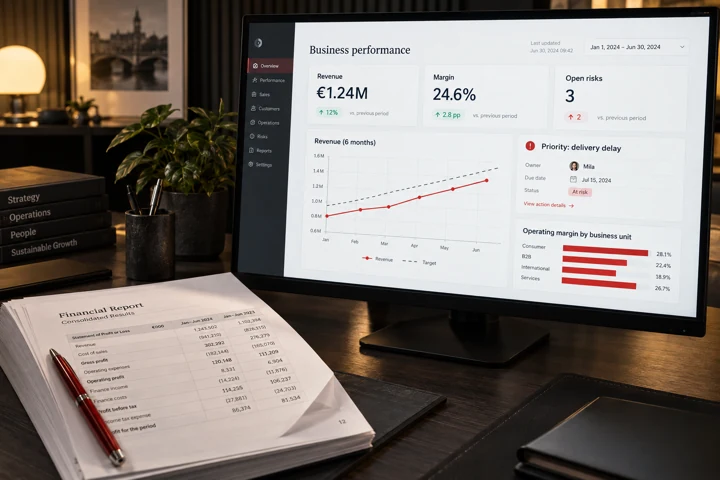
Many companies want dashboards. This is understandable. Management wants faster visibility, less waiting for reports and a clearer picture of business performance. The problem appears when a dashboard is built as a prettier version of an existing report.
Read article
Most companies already have a large amount of data. Sales has CRM records, finance has reports, operations has spreadsheets, support has tickets and marketing has campaign metrics. Still, more data does not automatically mean better decisions.
Read article
Automation sounds like a natural answer to slow work. If something is manual, repetitive or time-consuming, it makes sense to ask how it can be accelerated.
Read articleConnected tools and data. Less manual work, greater control.

Most companies measure sales, costs, projects and deadlines. Fewer measure how much time employees lose searching for information. Yet this is often a large hidden cost.
Read article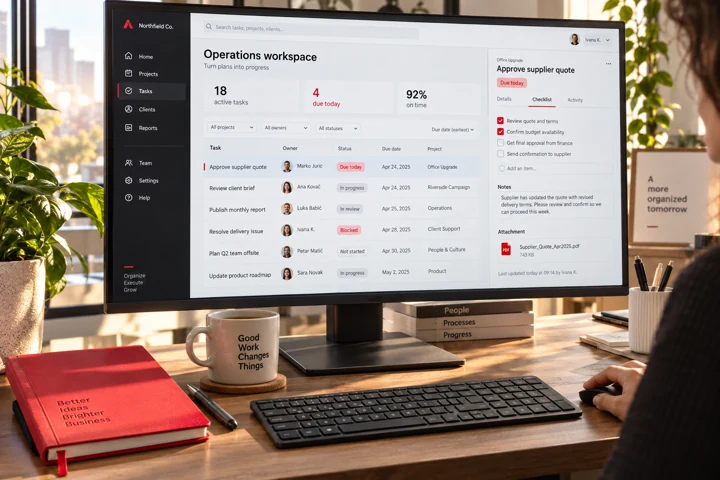
When a company is small, many things can be managed verbally, through messages, spreadsheets and informal agreements. People know each other, information moves quickly and a manager can often personally follow most important activities. The problem starts when the organization grows.
Read article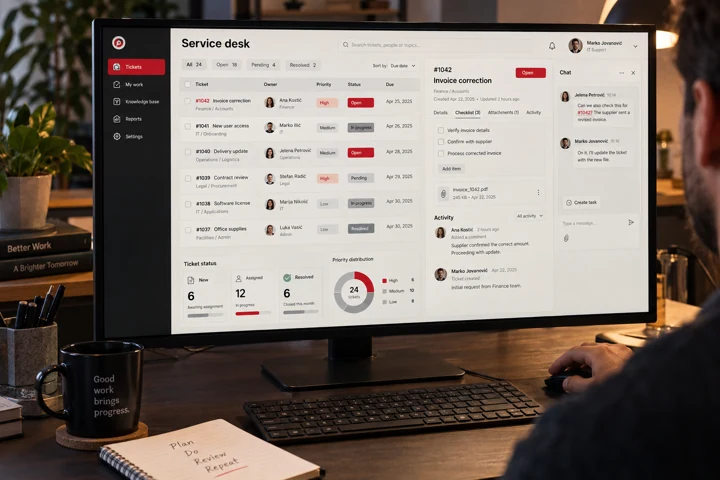
Messages are the fastest way to agree on something, but a poor way to manage work until completion. This applies to email, chat tools, internal groups and messaging platforms. The problem is not communication itself.
Read article
Many companies start digitalization with the right intention. One tool is introduced for communication, another for tasks, another for sales, another for documents, another for support and another for reporting. At first, each application seems to solve a specific problem.
Read article
When automation is mentioned inside a company, some employees immediately think about headcount reduction. Some managers, on the other hand, expect immediate cost savings. Both reactions are understandable, but they often miss the point.
Read article
Many companies want to automate business processes, but they are afraid automation will create more complexity, less control or resistance from employees. That fear is understandable.
Read articleA reliable IT foundation for everyday operations and growth.

What cloud storage is, why businesses adopt it and what to check before migrating: access, security, backups, costs, data regions and cloud deployment models.
Read article
A disaster recovery plan defines how a company restores systems, data and critical processes after a serious incident. The cause may be a technical failure, cyberattack, data loss, human error, equipment problem or service outage.
Read article
Business resilience is the ability of a company to continue operating when something fails: a system outage, data loss, cyber incident, process bottleneck, unavailable employee or supplier disruption. It is not only a technical topic and it cannot be solved with one tool.
Read article
Cloud migration makes sense when it solves a real business problem: scaling, availability, remote work, backup, faster deployment or better collaboration. It does not make sense when it is done because cloud is fashionable, without assessing applications, data, cost, security and user needs.
Read article
Hybrid IT systems connect local infrastructure, cloud services, users, data and security rules into one manageable environment. The value is not in using both cloud and on-premise systems. The value is knowing what belongs where, why it belongs there and who owns security, availability and cost.
Read article
Choosing between cloud and on-premise infrastructure is not only a technical decision. It is a business decision about control, cost, security, availability and growth. Cloud can provide flexibility and faster scaling. On-premise infrastructure can provide direct control.
Read articleProtecting data, people and operations. Preparation before an incident.

A practical approach to securing business IT systems: risk management, MFA, endpoint protection, segmentation, backup, monitoring and incident response.
Read articleHow antivirus software works, when built-in protection may be enough, and what businesses need from endpoint security, EDR and managed monitoring.
Read article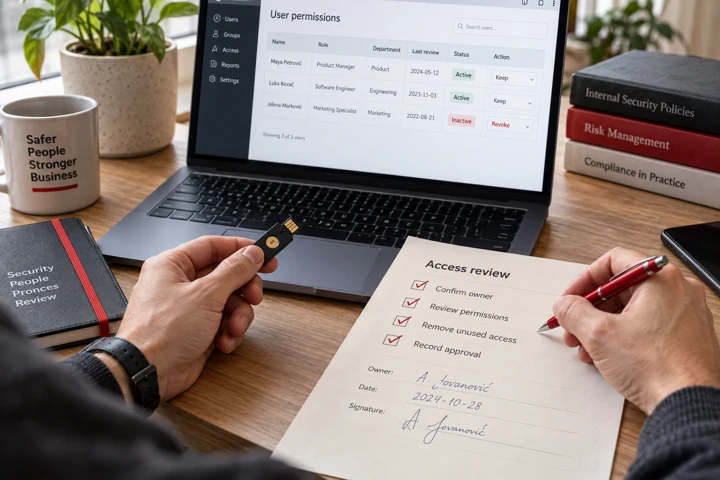
Security procedures often fail for a simple reason: they are written as documents, not as a way of working. The company gets a policy, a folder, a few general statements and the impression that something has been completed.
Read article
The NIS2 directive is a European framework that raised expectations for organizations that depend on digital systems. For companies outside the EU, including Serbian companies that work with EU partners, it matters because it shows where modern cyber risk management is moving: cybersecurity is no…
Read article
An information system security policy is not just a document created to satisfy a formal requirement. Its real value is to define how a company protects its systems, data, users, employees and business continuity.
Read article
In cybersecurity conversations, employees are often described as the biggest risk. That is a shallow and dangerous simplification. People can make mistakes, but they can also become the fastest sensor for a problem.
Read articlePersonal perspectives on technology, freedom, knowledge and the lives we want to build.

From YouTube Premium to a subscription-supported life: a personal reflection on rising expectations, convenience and the freedom to opt out.
Read article
AI can connect knowledge, work, wellbeing and decisions—provided we use it to improve our thinking rather than avoid the effort of understanding.
Read article
Personal principles for energy, calm, organisation, AI and leadership: pursuing meaningful results while protecting yourself and the people around you.
Read article
AI, health monitoring, implants and digital identity raise a question beyond capability: what do we gain, and what do we give up?
Read article
Digital formats make knowledge easier to access. A physical book can protect the quiet attention needed to turn information into understanding.
Read article
What is Google Gemini AI, and how can multimodal capabilities support business work? A 2024 perspective updated with practical guidance.
Read article