In this article9 sections
The management view
Choosing between cloud and on-premise infrastructure is not only a technical decision. It is a business decision about control, cost, security, availability and growth. Cloud can provide flexibility and faster scaling. On-premise infrastructure can provide direct control. For many companies, the best answer is not one extreme, but a hybrid model that fits real processes, data and risk.
Why infrastructure decisions belong to management too
Infrastructure affects how quickly employees work, how safely data is stored, how resilient operations are and how easily the company can adopt new digital solutions. That is why the decision should not be left only to IT. IT should lead the technical assessment, but management must define priorities, risks and expected business outcomes.
A company can buy a technically solid solution and still make the wrong business decision. It can overinvest in servers it will not use. It can move too much to cloud without cost control. Or it can keep outdated systems because they still work, even though they slow down employees and increase risk.
When cloud makes sense
Cloud makes the most sense when the company needs flexibility, faster deployment and less local maintenance. It is useful for companies that grow quickly, operate from several locations, support remote work or need services that can scale without long procurement cycles.
The decision should start with applications and data. Some systems are easy to move. Others depend on local equipment, specific integrations or strict internal rules. Cloud is powerful, but it is not automatically cheaper. It shifts the cost model from capital investment to recurring operating cost, and that cost needs ownership and control.
When on-premise still has value
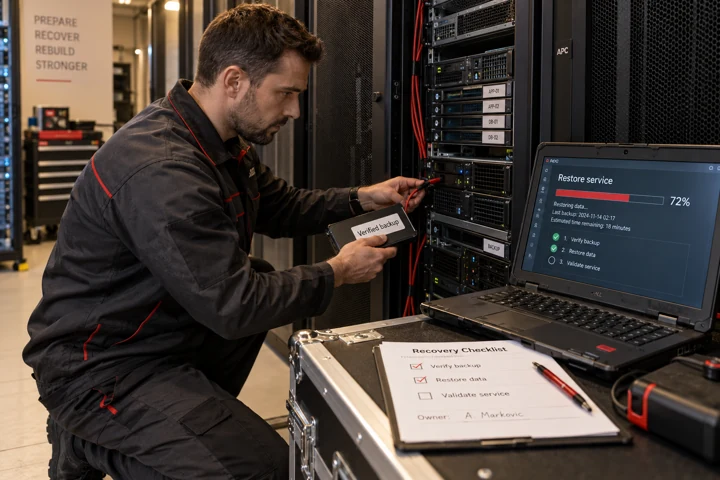
On-premise infrastructure is not outdated just because cloud exists. It can be the right choice when a company needs direct control, predictable local performance, specific configurations or special security requirements. The challenge is that this control comes with responsibilities: maintenance, monitoring, backup, lifecycle planning and recovery procedures.
The real risk is not on-premise infrastructure itself. The risk is unmanaged infrastructure that nobody reviews until something breaks.
Why hybrid IT is often the practical answer
Hybrid IT allows companies to keep some systems local and move selected services to the cloud. This can create a useful balance between control and flexibility. But hybrid architecture must be designed. Without clear rules, it creates confusion: data is duplicated, responsibilities are unclear and security policies are inconsistent.
A good hybrid model defines where each system belongs, how users access it, how backup works, who owns security and how performance is measured.
Questions to answer before the decision
Before choosing a model, management should answer practical questions. Which systems must not stop? Which data is most sensitive? Which teams depend on infrastructure the most? Which part of the current environment slows down work? Which costs are visible, and which are hidden in downtime, maintenance and employee frustration?
The company should also assess internal capacity. On-premise infrastructure requires maintenance discipline and lifecycle planning. Cloud requires cost control, access management and configuration governance. Hybrid IT requires even clearer architecture because it connects both worlds.
A good decision reduces uncertainty. After the assessment, the company should know what changes now, what stays as it is, what should be monitored and which business result is expected. Without that clarity, cloud, on-premise and hybrid IT remain labels, not strategic choices.
This is why infrastructure planning should be connected with the digital roadmap. A company that plans AI, analytics, automation or integrated business software needs an infrastructure model that can support those initiatives without creating new bottlenecks.
Common mistakes in the decision process
The first mistake is comparing cloud and on-premise only through price. The second is ignoring user experience. The third is moving too quickly without understanding dependencies between applications, data and processes. The fourth is assuming that the chosen model will manage itself.
A mature decision looks at cost, risk, scalability, user access, compliance, backup, recovery and internal responsibility together. This broader view is what turns infrastructure from a technical purchase into a business foundation.
Decision checklist for management
A useful decision checklist should include business criticality, sensitivity of data, expected growth, number of locations, remote work needs, integration requirements, internal IT capacity and acceptable downtime. These factors matter more than a general preference for cloud or local infrastructure.
The company should also define what success looks like six or twelve months after the decision. Is the goal lower risk, faster access, easier scaling, better collaboration, more predictable cost or stronger continuity? Without a measurable goal, every infrastructure model can look acceptable on paper.
The final decision should be documented in simple business language. Management, IT and operational teams should understand why the chosen model was selected, what will be changed first and what will be reviewed later.
Positive approach
Positive treats infrastructure as the foundation of digital transformation, not as an isolated hardware purchase. The right model should support business continuity, security, AI, business software and employee productivity. If you want to assess whether cloud, on-premise or hybrid infrastructure fits your company best, book a consultation and start with a structured review.
Related services: CoreTech IT infrastructure