In this article8 sections
Messages are good for communication, but poor for managing work
Messages are the fastest way to agree on something, but a poor way to manage work until completion. This applies to email, chat tools, internal groups and messaging platforms. The problem is not communication itself. The problem starts when tasks, tickets, projects and deadlines live only inside messages.
In such a system, work looks active. People write, reply, forward, tag and remind each other. But management often lacks a clear view of what has truly been accepted, completed, delayed, blocked or assigned.
That is why tasks, tickets and projects should not live only in messages. If key work exists only in communication channels, the company depends on memory, habits and individual availability.
Why work moves into messages
The first reason is speed. It is easier to send a message than to open a system, create a task, assign ownership, define a deadline and connect the request to a project or client. In the short term, the message feels efficient. In the long term, it creates debt.
The second reason is the lack of a clear system. If the company has not defined where requests are registered, where tasks are tracked, where projects are managed and where decisions are recorded, people will use the closest available channel.
The third reason is poor experience with previous tools. If software was complex, slow or too administrative, people return to messages. That does not mean the organization does not need a system. It means the system must be better designed for real work.
What is lost when work stays in messages
First, accountability is lost. A message may say that something should be done, but it is often unclear whether someone has actually taken responsibility. In a group chat, everyone may assume someone else will act.
Second, context is lost. A task is usually connected to a client, project, document, deadline, decision or previous communication. Messages do not preserve that context in a structured way.
Third, measurement is lost. Management cannot improve what is not recorded. If work lives in messages, it is difficult to see how many requests arrive, how long resolution takes, where bottlenecks appear and what types of problems repeat.
Communication is not an operating system
Communication helps people exchange information. An operating system helps the company manage work. These two layers should cooperate, but they should not be the same.
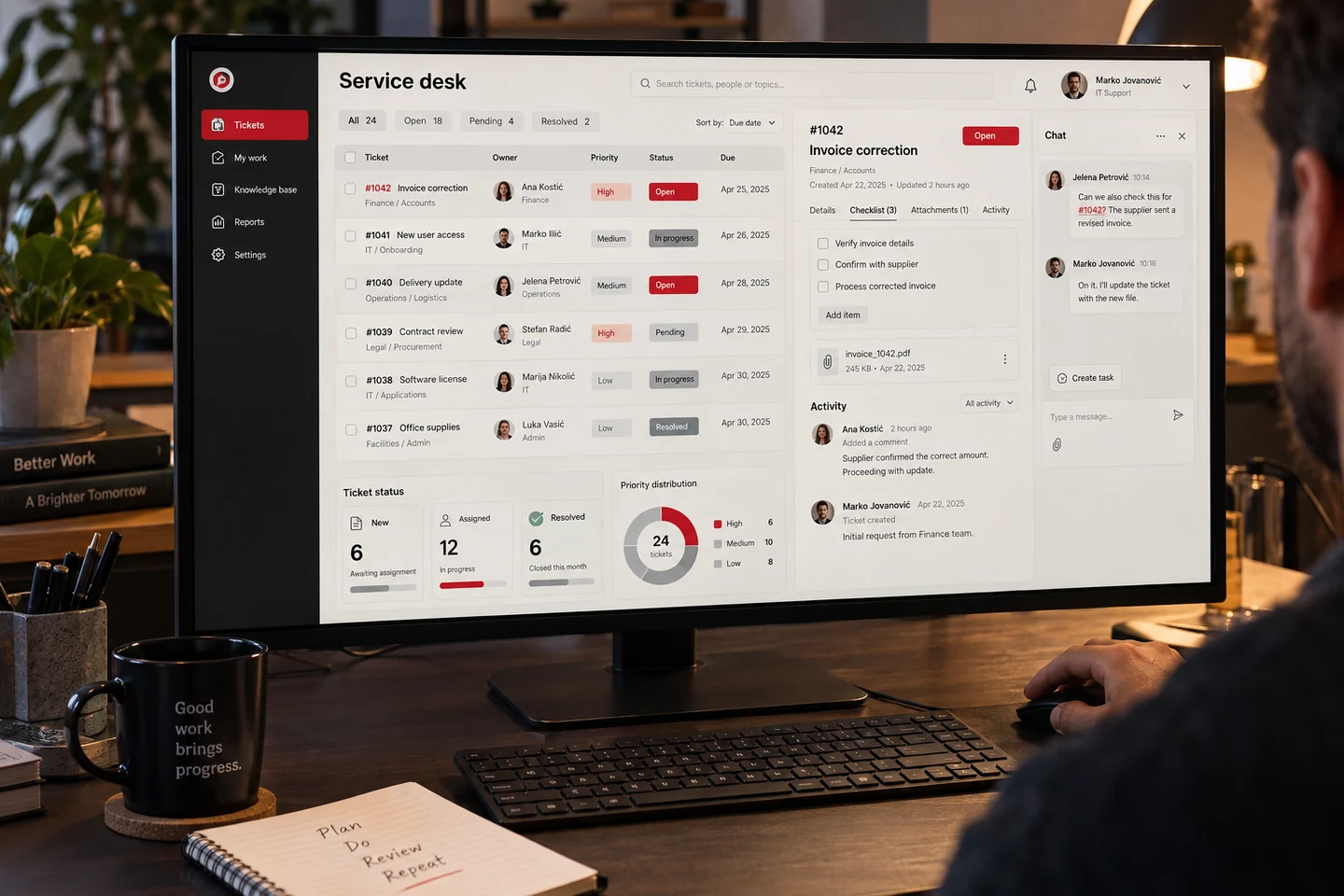
A message can start the process: someone reports a problem, forwards a request or agrees on a next step. After that, work needs structure: owner, status, deadline, priority, connection to a client or project and evidence of completion.
This is where ticketing, task management and project management tools matter. Their purpose is not to replace human communication, but to make sure agreements do not disappear.
How to move from messages to a managed workflow
The first step is defining what must no longer remain only in messages. This usually includes client requests, internal requests, tasks with deadlines, project obligations, issue reports and meeting decisions.
The second step is defining entry channels. A request can arrive by email, phone or message, but if it needs to be resolved, it must become a ticket, task or project activity.
The third step is defining statuses. If everyone uses different language, management still lacks visibility. Simple statuses such as new, in progress, blocked, waiting for client and completed often create more order than complex procedures.
The fourth step is regular review. A system has no value if nobody uses it for decisions. Short daily or weekly reviews bring accountability back into the workflow.
How to avoid turning the system into bureaucracy
One of the biggest employee concerns is that moving work out of messages will create more administration. That concern is valid if the system is poorly designed. If people have to fill in too many fields and update statuses without clear value, they will return to messages.
The solution is to start with a minimal set of rules. Each ticket or task should have an owner, a short description, a deadline or priority, a status and a connection to a client, project or internal area when relevant. Anything beyond that should exist only if it improves decisions or work quality.
What management gains
Management gains visibility. It no longer needs to ask each person individually what is happening. It can see open obligations, critical points and recurring problems. This is not micromanagement. A good system reduces the need for constant checking.
Teams gain clearer accountability. People know what belongs to them, what is urgent and what needs to be completed. When everything is in messages, work often depends on who is louder or who reminds more often.
Clients receive better service. Requests are not lost, statuses are clearer and the answer does not depend only on whether one specific person is available.
The Positive approach
Positive does not treat this as a software-only problem. If a company introduces a tool but does not change work rules, messages will remain the real place where business happens. That is why the company needs to define what belongs in a message, what must become a task, what must become a ticket and what belongs to a project.
Once those rules are defined, digital solutions can create real value. In the Positive ecosystem, PAM and ONE logic help tasks, tickets, projects and information move into one clearer operating space instead of staying scattered across messages and spreadsheets.
Frequently asked questions
Should messages be removed from work completely?
No. Messages are useful for communication. The problem is when they become the only place where tasks, deadlines and project obligations live.
What should be moved out of messages first?
Anything with a deadline, owner, client impact, project status or need for follow-up should move into a system.
Will employees accept such a system?
They accept it more easily when it reduces chaos and reminders instead of adding administration.
What is the difference between a task and a ticket?
A task is a broader work obligation, while a ticket is usually a request or issue that must be registered, tracked and closed through a workflow.
How can Positive help?
Positive helps define work rules, entry channels, statuses and digital solutions that support real business workflows.