In this article10 sections
Security has to become a documented system
An information system security policy is not just a document created to satisfy a formal requirement. Its real value is to define how a company protects its systems, data, users, employees and business continuity. When security depends only on IT habits, informal rules and individual experience, risk stays hidden until an incident occurs.
Many companies already have parts of the system: antivirus, backup, passwords, network rules, user accounts and some procedures. The problem appears when these parts are not connected into one understandable and manageable framework. Then management does not know who is responsible for what, employees do not know what is allowed, IT lacks clear authority, and legal or operational teams lack evidence that risks are being managed systematically.
This is why cybersecurity has to be treated as a business discipline, not only as technical protection. The policy is the point where technical measures, organizational rules and management responsibility become a practical operating system.
The short management answer
An information system security policy defines the rules, measures, responsibilities and procedures through which a company manages the security of its information systems. Its goal is not only formal compliance, but lower risk, clearer responsibility, better incident response and greater business resilience.
What the policy must solve in practice
A good policy should not be a collection of generic statements. It must answer practical questions: which systems are critical, which data matters most, who has access, how access is approved, how changes are controlled, what happens during an incident and how the company checks whether measures actually work.
The first area is the map of systems and responsibilities. A company has to know which ICT systems support key processes. A problem in a supporting tool is not the same as a problem in a system that supports sales, finance, customer support, production or client communication.
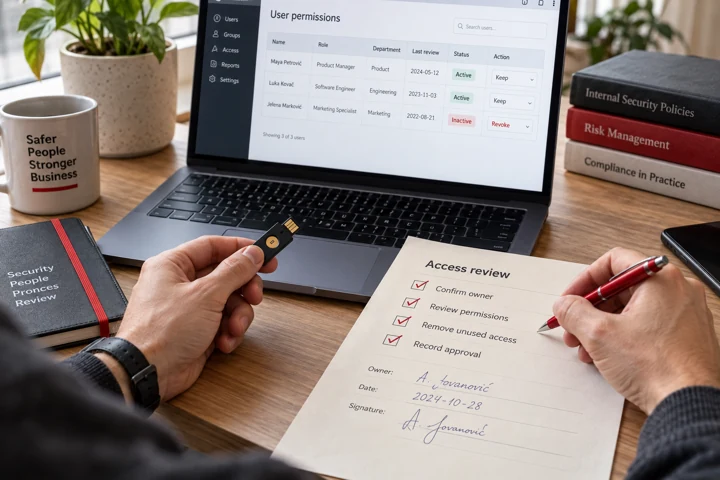
The second area is access and identity. Many serious incidents start simply: users have too many rights, old accounts remain active, passwords are shared, external partners keep access for too long or administrative rights are used without enough control.
The third area is incident handling. A company must know who reports an issue, who receives the escalation, who decides whether a system should be stopped, who communicates with users and how evidence is preserved.
Why this is not only an IT task
IT can implement measures, but it cannot alone decide what is business-critical. It cannot alone assess reputational risk, contractual obligations, legal requirements or operational priorities. That is why IT infrastructure and security must be connected with management, legal, finance, HR and process owners.
When the policy is written only by IT, it often becomes a technical document that management does not use. When it is written only by legal teams, it can become a formal document that technical teams cannot implement. The right approach is joint work: precise enough for control, clear enough for people and realistic enough for daily use.
The real goal is a more mature operating system
An information system security policy should be the beginning of more mature digital risk management. It does not guarantee that incidents will never happen, but it increases the chance that the company knows what to do, who decides, how to respond and how to return business operations to normal.
Before publishing or implementing any legal document, companies should check the current legal framework and involve a legal advisor. Business and technical preparation can accelerate the process, but legal validation should remain part of the final review.
Common weaknesses in existing security documents
The first weakness is copying generic language that does not match the real business. If the document describes measures the company does not have, tools it does not use or processes that do not exist, it helps nobody. It creates a false sense of security.
The second weakness is unclear responsibility. Documents often say that a “responsible department” should do something, but do not say who approves access, who reviews exceptions, who leads an incident and who reports to management.
The third weakness is lack of review. A policy that is not reviewed becomes outdated as new tools, employees, suppliers and habits change the risk profile.
A realistic starting minimum
The company does not need an overcomplicated system at the start. It needs a map of critical systems, a basic access matrix, a list of important data, an incident reporting procedure, backup and recovery rules, and an employee training plan.
After that, the system can mature through deeper risk assessment, data classification, periodic checks, exception records, recovery tests, supplier control and management reporting. The key is to start with something practical enough to be used.
If the policy is meant to support management, it must connect with daily decisions. Then management understands risk, IT knows what to implement and employees know how to behave.
Why legal, business and IT language must meet
The final document should not speak only legal language or only technical language. Legal wording gives structure and accountability. Technical wording explains what can actually be implemented. Business wording explains why the rule matters and what risk it reduces.
When these three languages do not meet, the policy becomes hard to use. Management sees it as a formal document, IT sees it as incomplete, and employees see it as something unrelated to their work.
The best policies are not the longest ones. They are the ones that help people make better decisions when the situation is unclear or risky.
Questions clients usually ask
Does every company need this type of policy?
The legal answer depends on the current regulation and the company status. Even when it is not formally required, documented security procedures are a strong practice for companies that depend on data and digital systems.
Who should participate?
IT, management, legal, HR and owners of key processes. If only one department writes the policy, it may be incomplete or hard to implement.
Is buying security software enough?
No. Software is important, but without procedures, responsibility, training and control, protection remains partial.
How often should it be updated?
Whenever systems, processes, people, risks or regulations change. A yearly review is a practical minimum.
What is the first step?
Map critical systems, data, access rights and business processes.
The next step for companies that want a more mature system
If you want to check whether your security procedures are clear enough, booking a consultation is a practical first step.
Related services: business consulting