In this article14 sections
One weak link should not stop the whole company
Business resilience is the ability of a company to continue operating when something fails: a system outage, data loss, cyber incident, process bottleneck, unavailable employee or supplier disruption. It is not only a technical topic and it cannot be solved with one tool. Resilience appears when IT infrastructure, processes, data, people and responsibilities work as one system.
Many companies think about resilience only after something has already stopped working. At that moment they often discover that backup was never tested, documentation is incomplete, responsibilities are unclear and customer communication depends on improvisation. The problem is not only the incident itself. The real problem is that the organization has no agreed way to survive it.
In digital business, stability is not a luxury. It is a condition for sales, service, delivery, reputation and trust. If a company cannot continue operating in a critical moment, digital transformation remains a nice idea without operational strength.
Resilience starts with knowing what must never stop
The first step is not buying new software. The first step is understanding which parts of the business must keep running. For one company it may be sales and orders. For another it may be production, customer support, field service, documentation or finance.
Management needs to know which processes are critical, how long they can be unavailable, which data is required to continue work and who is allowed to activate an alternative operating mode. Without those answers, the company depends on individual reactions. That may work while the organization is small, but it becomes risky as complexity grows.
This is why resilience has to be connected with digital transformation. Digitalization is not only about working faster when everything is normal. It should also create visibility, structure and continuity when conditions are not ideal.
The most common weakness is unclear ownership
When a system fails, people usually ask what broke. That is important, but not enough. The equally important question is: who decides what happens now. If there is no owner for the process, data, communication and technical recovery, the problem spreads faster than it is solved.
In practice, IT may try to fix the technical issue without understanding business priorities. Management asks for status, but there is no single source of truth. Employees send messages across multiple channels. Customers receive inconsistent answers. A technical incident becomes a business incident.
Resilience requires clear ownership. Every company does not need complex procedures, but it must know who leads recovery, who communicates with customers, who checks data, who decides priorities and who confirms that the system is back to normal.
Backup matters, but it is not the whole system
Data backup is one of the most important layers of resilience, but it is not enough on its own. A company may have backup and still not know how quickly it can continue working. It may have copies of data, but no recovery procedure. It may have an archive, but no clear understanding of which data matters first.
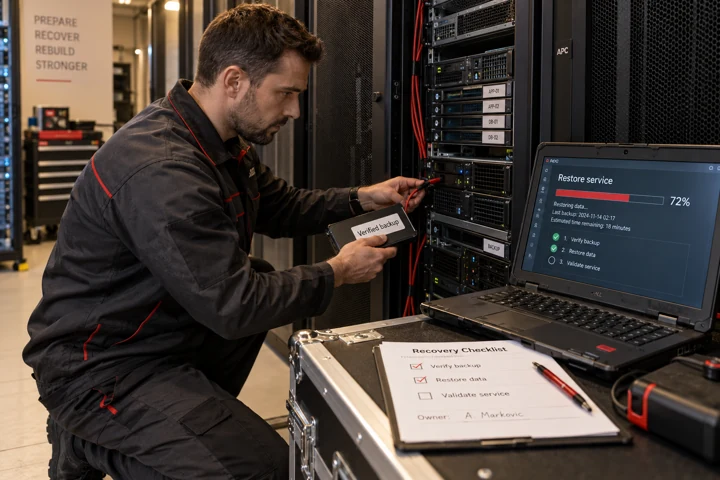
The right question is not only “do we have backup”. The right question is: what do we restore first, how long does it take, who verifies it and how do we know the restored data is usable. If backup is never tested, it is an assumption, not protection.
Business resilience connects backup, disaster recovery, access management, security procedures and operational priorities. The goal is not to avoid every problem. The goal is to prevent a problem from becoming a complete business stop.
Cybersecurity is part of continuity
Cyber incidents can block access to systems, data and customer trust. That is why cybersecurity should not be treated as a separate technical topic. It is part of business continuity.
If an employee clicks a phishing message, if an account is compromised or if data becomes unavailable, the company needs more than prevention. It needs a way to continue operating, communicate clearly, assess damage and restore work without creating additional risk.
Security, backup and continuity have to work together. If they are managed separately, each team will look at only one part of the incident. The company needs one operational view: what is affected, what is critical, what is already protected and what happens next.
Digital tools help only if they create structure
Software can improve resilience, but only if it brings order into daily work. If a company uses too many disconnected tools, resilience decreases. Information is scattered, responsibilities are unclear and in a crisis no one knows which version of data is correct.
Well implemented digital solutions should provide visibility over tasks, documents, customers, projects, tickets and responsibilities. When work is centralized, the company can more easily see what is critical, what is active, who is responsible and what has to continue even if part of the system fails.
Resilience is therefore not only something that exists in the background. It is visible in everyday work. If the organization is structured when things are normal, it can react better when things are not.
A practical resilience framework
A company does not need to start with a complex enterprise model. It can start with a practical framework that management can understand and lead.
- Define critical processes that cannot be unavailable for long.
- Define the data and systems required for those processes.
- Check whether backup is tested and recovery is realistic.
- Assign owners for processes, data, communication and technical recovery.
- Prepare simple response scenarios for common disruptions.
- Test at least once a year what happens when a key system is unavailable.
- Connect IT, security, operations and management into one plan.
This framework does not solve everything, but it changes the mindset. The company stops asking only “what if something happens” and starts knowing what it will do when it happens.
Positive perspective: resilience as a business system
Positive looks at business resilience through a wider lens: technology, processes, data, people and responsibilities have to work together. We do not start only with one question, such as whether backup exists or whether antivirus is installed. We start with how the company works, where the critical points are and what must be connected for the business to continue.
Sometimes the priority is infrastructure. Sometimes it is security. In other cases the weakness is documentation, ownership or disconnected tools. Often the right answer is a combination of layers. That is why an ecosystem approach matters: technology should not be seen in pieces, but as a system supporting business continuity.
If you want to assess how resilient your business is, the first step is not a large implementation. The first step is a structured conversation about what must not stop and what would happen if it did.