In this article9 sections
Information search is a hidden cost companies rarely measure
Most companies measure sales, costs, projects and deadlines. Fewer measure how much time employees lose searching for information. Yet this is often a large hidden cost. People search emails, messages, folders, old documents, local files and internal portals for things that should be available in seconds.
Internal knowledge search becomes important when a company realises that productivity depends not only on the number of people, but also on how quickly those people reach accurate information. If one request requires interrupting three colleagues, the system is not efficient.
This cost rarely appears as a single line in financial reports. It appears through slower work, repeated questions, longer onboarding, mistakes, frustration and weaker customer experience.
Why ordinary search is often not enough
Classic folder and keyword search helps only when people know exactly what they are looking for and when documents are named properly. In practice, employees often know the problem, not the file name. They are looking for an answer, not for “Procedure_v3_final.pdf”.
Keyword search reaches its limit when documents use different language from the employee’s question, when multiple versions exist or when documents are too long to read quickly. It is better than chaos, but not enough for fast operational work.
More advanced AI document search can understand the question, find relevant sections and summarise the answer. But it still needs structured sources, access rights and knowledge ownership.
Good search must know who is asking
Not every search is the same. A director, support agent, service engineer, salesperson and HR specialist need different types of information. If the system returns the same kind of results to everyone, it will only be partly useful.
A good search system starts with personas and scenarios. Who asks? What do they ask most often? Why do they need the answer? How quickly do they need it? Which sources are they allowed to use?
When these questions are clear, an employee knowledge base becomes more than a repository. It becomes a tool for real work situations.
Trust depends on sources, not only on speed
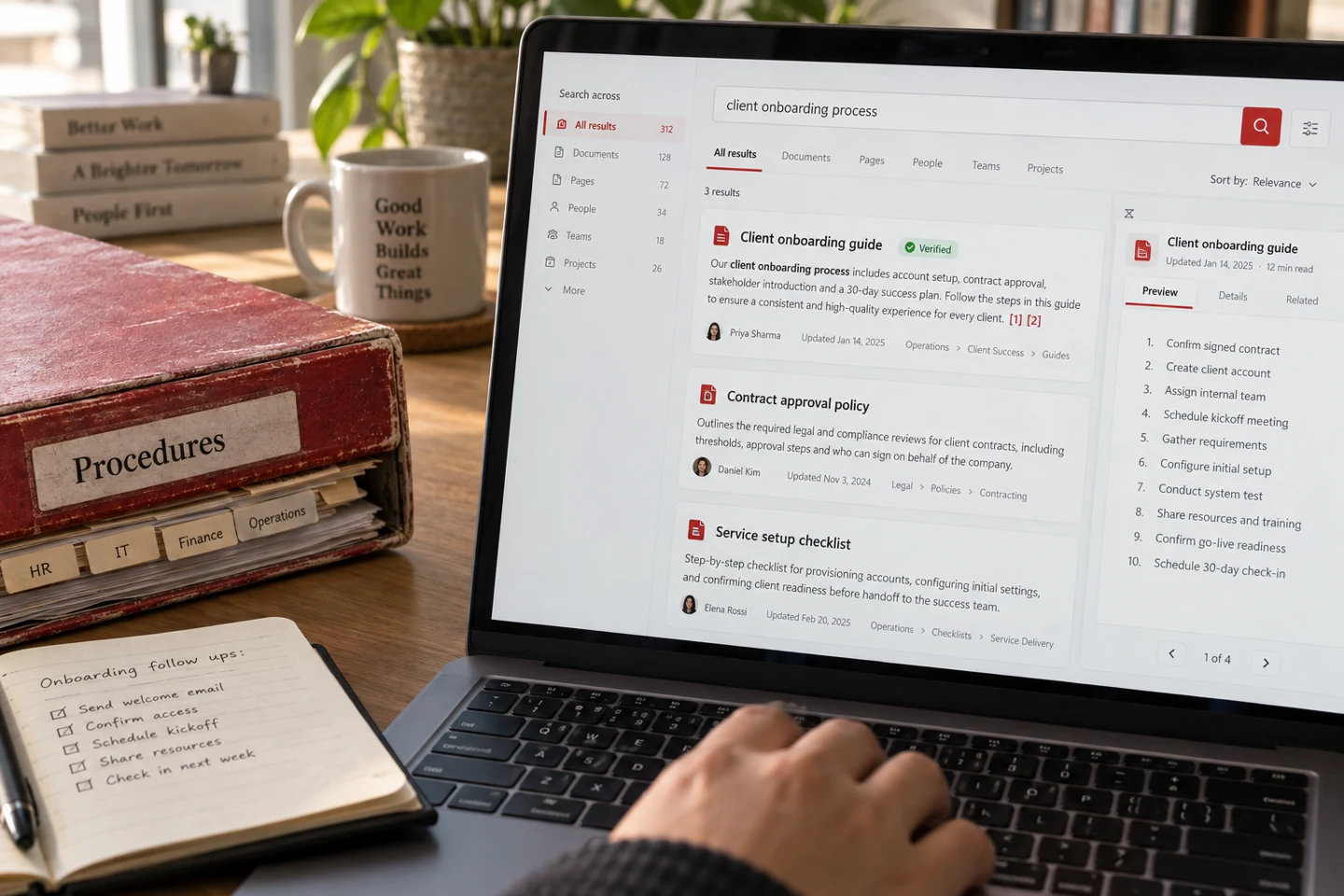
A fast answer is not enough if employees do not trust it. Internal search must show where the answer came from. If AI summarises a procedure, the user should be able to see the source. If several versions exist, the system should help distinguish the valid one.
Trust is built through official sources, version control, content ownership and a way for users to report inaccurate or incomplete answers. Then search becomes a living system, not a static archive.
This is especially important for legal, financial, security and contractual information. Employees must not only find an answer. They must find the right, verified and permitted answer.
From folders to intelligent search
The path does not need to be complicated. First, map the sources: where documents are, which systems exist, what people search for and who uses the information. Then choose one priority area instead of trying to cover everything at once.
The next step is cleaning and tagging content: valid versions, owners, categories, confidentiality and access rights. Then test the system with real questions, not only prepared demo questions. Finally, build adoption rules so people know when and how to use it.
Only then does company document search become part of work. Employees interrupt each other less, management gets information faster and customers receive more consistent answers.
Where internal search creates value fastest
The fastest value usually appears where there are many repeated questions: customer support, service, sales, HR onboarding, legal, internal IT support and operations. The knowledge often exists, but it is not easily accessible.
Field teams are another strong use case. They often work under pressure and need quick access to procedures, contracts, technical information or case history. Internal search directly affects speed and service quality.
Management also benefits. When leaders cannot access reliable information quickly, decisions are delayed or based on incomplete data. Internal search does not replace judgement. It improves the starting point for decisions.
Design search around real employee questions
Internal search should not be designed around folder structure, but around the questions employees actually ask. They rarely use the language of documentation. They ask practical questions: what should I tell the client, where is the contract, which deadline applies, who receives the escalation, what was the last agreement or how do we handle this exception.
Before implementation, it is useful to collect 30 to 50 real questions from the target area. These questions should come from people doing the work, not only from management. Operations know where the friction is.
Testing the system on real questions gives a much better signal. The question is not whether technology can answer a prepared demo question. The question is whether it helps in real work.
How internal search changes team behaviour
Good search does not only change speed. It changes team behaviour. When people know there is a reliable source, they rely less on messages, interrupt colleagues less and stop keeping information in private notes.
Adoption matters as much as implementation. The team should know when to use search, when to update the knowledge base, whom to notify about a wrong answer and how to suggest new content. Without these rules, people return to old channels because they are familiar.
When adopted well, search becomes a quiet productivity layer. It does not need to be spectacular to be valuable. It only needs to reduce interruptions, speed up answers and help people work with less friction every day.
Questions management usually asks
What is internal knowledge search?
It is a system that helps employees quickly find accurate information from internal documents, procedures and knowledge bases.
Is AI search better than ordinary search?
It can be much more useful because it understands questions and context, but only if sources are structured and access rights are clear.
Which areas should be included first?
Areas with repeated questions: support, service, sales, onboarding, internal IT, legal and operations.
How are wrong answers prevented?
By using official sources, content ownership, version control, access permissions and user feedback.
How can the effect be measured?
Through time to find information, repeated question reduction, fewer interruptions, faster onboarding and better customer response quality.