In this article22 sections
When the benefit becomes more persuasive than the fear
People make choices around what they hope to gain and what they fear losing. That helps explain why a profound change can arrive as a sequence of individually reasonable decisions. Each upgrade is useful and easy to justify. Only later do we notice that we have changed the wider system in which we live.
AI occupies a large part of my life because my company develops AI solutions. ChatGPT has also become an almost constant companion to my curiosity: the childhood book of a thousand questions has become a place to ask a billion more.
I use technology to improve companies and my own life. Yet the first time I seriously questioned how far I was willing to go with AI did not begin with philosophy. It began with an ordinary goal: organising and understanding my health information.
Better context, and a more difficult question
A clinician often has limited time and a small snapshot of a patient's life. Important context may sit in patterns of sleep, stress, food, exercise and everyday behaviour that are difficult to reconstruct during an appointment.
I created a ChatGPT project containing information I could describe or measure: blood test results, eating habits, training and daily routines. Organising it helped me notice patterns and formulate better questions.
I did not use AI as a replacement for a doctor. I treated it as an additional, fallible adviser whose suggestions needed checking. Its value was in helping me connect information and approach decisions more consciously, rather than transferring medical responsibility to a model.
That felt like a personal gain. It also opened a harder question: once more context appears useful, where does the desire for still more context lead?
When continuous monitoring starts to feel normal
The first step is straightforward: enter information and receive an analysis. The next seems logical: why rely on occasional snapshots if a continuous record could reveal more?
Imagine a future implant that monitors bodily changes, detects possible problems and calls for help after an accident. This is a speculative continuation of the appeal of wearable devices: closer to the source, more continuous and potentially more useful.
I sometimes joke that I will report back as soon as I have one installed. Behind the joke is a real boundary. I would want to choose what was monitored and retain a reliable way to switch it off. An implant I could neither disable nor remove is not an attractive proposition to me.
At that point, technology risks becoming a condition of participation rather than a tool I control.
The mind becomes the next frontier
If monitoring the body seems valuable, monitoring mental strain may become the next proposal: noticing exhaustion, stress or the approach to burnout before it is visible to others.
Science fiction offers familiar versions of the always-present adviser, from HAL to Cortana and Tony Stark's assistants. It sees the larger picture, accelerates decisions and may eventually act on what it predicts we would want. At some point, the distinction between user and assistant becomes less comfortable.
An adviser always operates towards some objective. Optimising for my wellbeing and optimising for profit, compliance or control can produce recommendations that sound equally helpful while leading in different directions.
The essential question is who sets the objective. A powerful adviser is not automatically an independent one.
Life logging and the right to disconnect
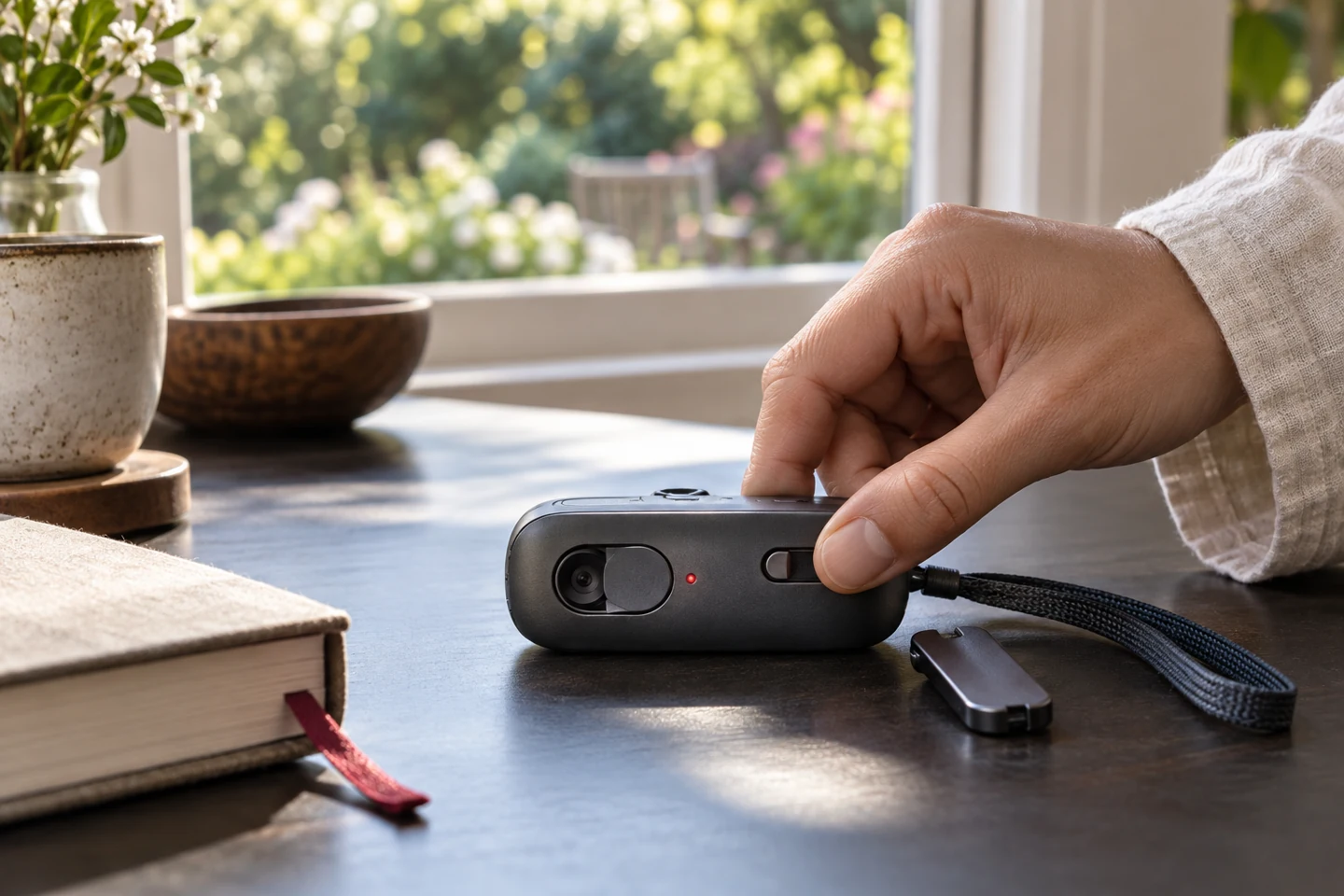
The richer an AI's context, the more useful it may appear. An entire life is a particularly rich source. That makes continuous recording of what we see and hear an understandable next ambition: preserve everything, review it later and learn from the record.
Black Mirror has explored this idea memorably. Imagine replaying a conversation while asking AI how you should have approached someone you liked. Social media and smartphones have already made the habit of optimising our presentation through a screen familiar. A complete recorded life would take it much further.
My boundary is the same as with the implant: I need a real, verifiable ability to turn the system on and off, alongside sensible limits on its use.
Recording around the clock without that choice is not simply another convenient feature. It threatens privacy and security. Once everything becomes data, it becomes commercially useful. Once it is commercially useful, someone will seek influence over it.
A system that can analyse me more accurately than I can analyse myself may also become very effective at influencing me. The question is how subtly it can do so.
The upgrade economy
We often hear that data is the new oil. I think the more uncomfortable possibility is that the person becomes the resource.
Longer life, lower risk, better sleep, greater productivity and stronger physical capabilities make powerful commercial promises. People rarely decide they have had enough quality of life. We adapt to improvements, then look for the next one.
My own priority is the quality of life, not its duration alone. Yet that very desire creates a market in layers of improvement. One upgrade seems reasonable. Another becomes useful. A third becomes socially expected. Differences in access to those upgrades could create new forms of inequality.
Fiction helps us test the implications before the hardware exists. The commercial logic can reshape life long before a device is placed under the skin.
When an adviser becomes an agent
The next step is not merely an AI that recommends, but an AI that acts: arranging appointments, making purchases, negotiating, managing messages, filtering information and taking small decisions.
That can save time. It also transfers authority.
The question becomes whose interests the agent protects. Most people may not experience this as giving up part of the steering wheel. They may experience it as a welcome reduction in everyday friction.
Persuasion tailored to the individual
An AI that understands someone's emotional triggers could make influence highly personal. A message can arrive when a person is tired, hurt, under pressure or particularly receptive to reassurance.
The result may not feel like external pressure. It can feel like a decision that naturally belongs to us.
That possibility matters in advertising, politics and everyday recommendation systems. Technology can help us become more capable while also guiding us towards someone else's preferred outcome. We need to recognise both possibilities.
Access as a quiet form of power
A society does not need one official social score for scoring to influence daily life. Separate credit, insurance, employment, security and health assessments can shape which opportunities are available.
Nobody necessarily issues a direct prohibition. A better insurance offer, a job, a faster appointment or a financial product simply becomes unavailable. Control can operate through the architecture of access rather than through an explicit command.
The concern is not that every assessment is illegitimate. It is that their combined effect may become difficult to understand, challenge or escape.
Digital identity and anonymity
Biometric and cryptographic identity systems can reduce fraud and improve reliability. They can also make identification the default condition for an expanding range of activities.
If every significant interaction is measured and verified, privacy may become harder to retain. An efficient system can still leave important questions about freedom unanswered.
The organisation that determines the available options may not need to apply visible pressure. It has already shaped the decision before we make it.
A digital layer over the physical world
Augmented reality may matter as much as an entirely separate virtual world. Glasses and audio assistants could add navigation, translation, information and instructions to everyday surroundings.
Much of that would be useful. But a continuous interpretation of the world is also a filter. Whoever operates it helps determine what we notice and how we understand it.
The problem is not that an additional layer exists. It is that an apparently neutral layer may carry objectives and assumptions we did not choose.
A model that predicts you
Consider a digital model of a person's body and behaviour, used to explore what might happen if certain habits continue. As a research or health-support concept, the potential is considerable.
The same predictive capability could be attractive to someone seeking influence. The distinction between helping and manipulating may depend on purpose, authority and control rather than on the technical sophistication of the model itself.
That is why the question of who holds the information matters as much as what the system can calculate.
Skills we may need to protect
Remembering telephone numbers is less necessary than it once was. Other capacities may also weaken if we consistently delegate them: sustaining attention, tolerating boredom, holding an unmediated conversation, or thinking through a choice without an external prompt.
These may sound like small matters. To me, they are part of the practical capacity to remain independent.
A person can be productive and highly functional while becoming less comfortable making decisions without assistance. Efficiency alone does not tell us who is deciding.
Two different directions for technology
Some technology increases human capability and responsibility. Other technology gradually substitutes for them, increasing dependence and reducing autonomy.
Both may promise convenience, safety and a better life. The difference can become visible only over time.
That distinction is one of the most useful questions I can bring to any new capability: does it help me become more able, or less able to act without it?
The attraction of a longer life
Humanity has long imagined escaping mortality. Advanced longevity and the possibility of transferring consciousness are among the most ambitious scenarios, although they should not be confused with established capabilities or a reliable timetable.
As a thought experiment, imagine a society that fixes a lifespan of 120 years. Once the clock runs down, there is a formal ending. Now imagine the incentives to alter the clock, purchase extra time or gain access through status. A fictional premise immediately reveals familiar human behaviour: privilege, markets and attempts to bend the rules.
The film In Time turns time into currency. Another version might turn access to better health into a continuing subscription. The technology is speculative; the questions about fairness are recognisable now.
Treatment and the ambition to redesign people
Genetic technologies raise another boundary. Preventing serious disease and helping families are compelling aims. Designing people around commercial ideals of status, appearance or performance is a different ambition.
My concern is the difficulty of maintaining a stopping point once improvement itself becomes a competitive market. The boundary can move one package at a time, with every step justified by a benefit.
I want to preserve a distinction between helping a person and treating the person as a product to be redesigned.
Virtual worlds as tools and as substitutes
Immersive environments could make collaboration and education richer. People could meet without travel, explore a historical setting, examine a model of the human body or learn through a simulated environment.
I can see considerable value in that. I also see a problem if a virtual experience consistently replaces going outside, spending time with people or remaining engaged with physical life.
Ready Player One and Surrogates offer useful fictional warnings. A highly attractive environment can still become a form of confinement if we lose the ability or motivation to leave it. New platforms also bring familiar possibilities for fraud, manipulation and harassment.
For me, the value depends on limits and a continuing connection with the world outside the interface.
Why I expect the pressure to continue
My expectation is that technologies offering visible improvements in health, safety or convenience will keep attracting adoption. Each immediate decision can be rational while the accumulated consequences remain unclear.
The competition for resources, markets and influence is not new. What changes is how closely it can reach into bodies, mental life and decisions.
Regulators will have to address the incentives of companies monetising human improvement and institutions seeking greater access to personal information. Rules and penalties matter, but a growing collection of forms is not enough by itself. We also need understandable principles, enforceable boundaries and mechanisms that people can actually use.
That requires participation from individuals as well as institutions. If we do not learn enough about the technologies and their consequences to take part, we may help create systems that are modern and efficient without being fair or free.
My three boundaries
I do not assume that either commercial or state institutions will put my interests first. Their incentives deserve scrutiny even when the explanation offered to the public sounds reasonable.
For me, freedom is about more than whether someone possesses information. It is also about whether they can use it to steer my choices, close off opportunities or make the quality of my life conditional on compliance.
That is why I keep returning to three personal boundaries:
- Redesigning humans as commercial products through genetic enhancement, rather than treating disease.
- Implants or continuous recording that I cannot reliably switch off.
- Virtual environments that displace meaningful participation in physical life.
These are my starting points for a difficult discussion, not a claim to have resolved every case.
A mental exoskeleton before a physical one
If I had to describe the direction I expect, I would begin with a mental exoskeleton: AI supporting attention, understanding and decisions. A physical layer of interfaces, assistive devices and possible implants may follow.
The Iron Man comparison is useful less for its spectacle than for the dependence on an enabling system. What matters is who controls that system and, especially, who controls its off switch.
Greater capability is valuable. So is the ability to withdraw consent.
Adaptation does not settle the question of value
Smartphones, headphones, watches and connected homes already look ordinary to many people. Earlier generations would have found parts of that routine strange. Future generations may feel similarly comfortable with capabilities that unsettle us now.
As the environment becomes more digital, closer connections between people, software and machines may become increasingly attractive. I am describing a direction I expect, not saying that I welcome every part of it.
It could help people escape illness and some biological limits. It could also become a sophisticated way to turn human life into a resource, exchanging independence for convenience, safety, health and the ability to function normally in society.
The difficulty is that each step can look like progress on its own.
The balance that remains

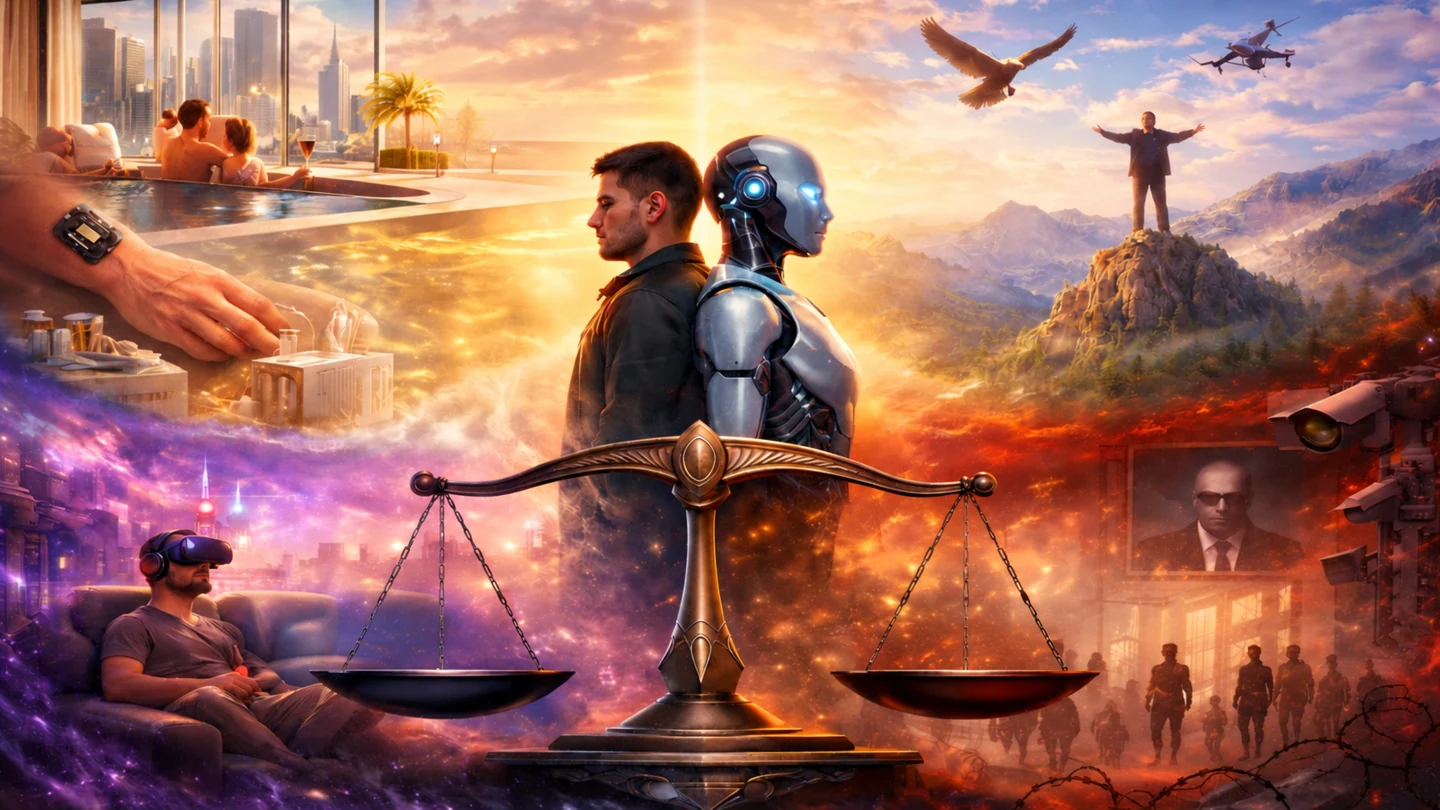
On one side of the scale sit comfort, health, safety and belonging. On the other sits freedom.
The technologies discussed here—continuous monitoring, AI agents, personalised persuasion, identity systems, augmented reality, digital models, virtual worlds and genetic engineering—are different versions of one question: what do we gain, and what do we surrender?
I want to leave that question open. It cannot be settled by a single enthusiastic or fearful position. Sooner or later, each of us will have to answer it in practical choices.
Where does the person end and the machine begin?
Where do we draw the line between convenience and privacy?
Related services: trust and security