In this article9 sections
When every system tells its own truth
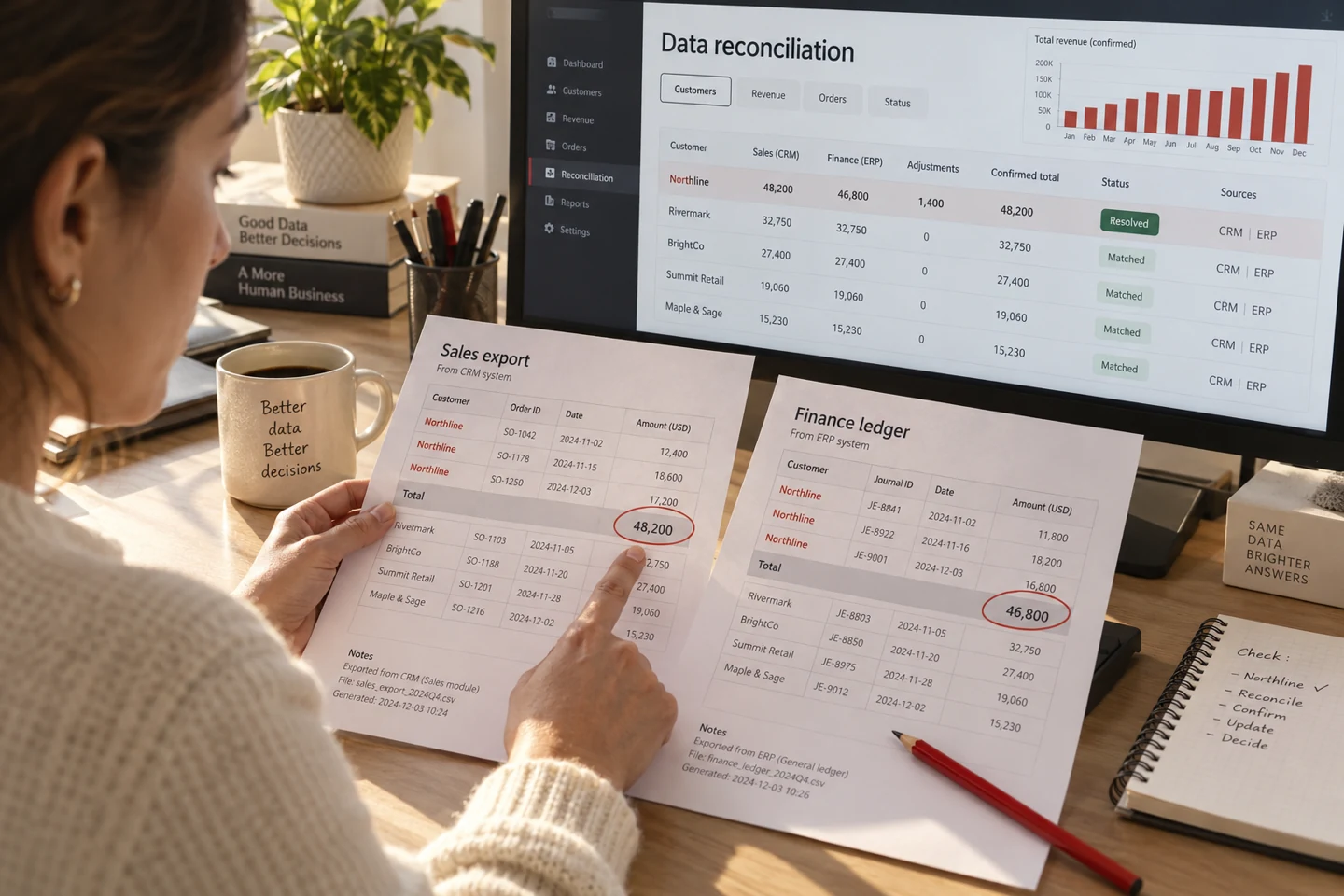
In many companies, sales, finance, operations, support and marketing use different systems. That is not automatically a problem. The problem starts when the same customer, revenue, status or task looks different depending on which system is used.
Data from multiple systems can be a strength if it is connected and interpreted correctly. It can provide a broader picture of the business. But if it is not aligned, management may make decisions based on incomplete, outdated or contradictory information.
Time is then spent not only on analysis, but on reconciliation. Meetings become discussions about whose spreadsheet is correct, while the real business decision remains in the background.
Multiple systems are not the real problem
It is not realistic to expect every company to have one system for everything. Even with a central platform, there may be separate tools for finance, sales, marketing, support, documentation or infrastructure. Different systems are acceptable if each has a clear role.
The problem is not the number of systems, but the lack of data architecture. If the company does not know where the original data is created, who updates it and how it moves further, the number of systems becomes a risk.
Data integration is not only technical connection. It includes agreement about data meaning, processing rules, ownership and usage. Without that agreement, integration may only move bad data faster.
Single source of truth as a management principle
A company needs to decide which system is the source of truth for each type of data. CRM may be the source for sales opportunities. Finance may be the source for invoices and collection. A ticketing system may be the source for customer requests.
This decision may sound simple, but it is often critical. If no one knows which system has the final word, people manually adjust reports. This may solve a presentation problem short term, but it destroys trust in data over time.
A single source of truth does not mean that all data must live in one tool. It means that key business concepts have a clear definition, source, owner and role in decision-making.
How poor decisions happen
Poor decisions often do not happen because management cannot think well. They happen because management starts from a distorted picture. If the pipeline is not updated, the sales forecast is wrong. If stock data is not connected with sales, promises to customers may be unrealistic.
Partially correct data is especially dangerous. It looks convincing, but misses important context. For example, a growing number of leads may look positive, but if lead quality is dropping, the sales team may be wasting time.
That is why business analytics must connect several sources and also show the limits of data. Management needs to know not only what the number says, but how much it can trust it.
A practical model for organizing data
The first step is listing key business data. This does not mean every data point the company owns, but the data used for decisions: customer, contact, opportunity, contract, invoice, ticket, project, task, stock, cost and revenue.
The second step is mapping sources. For every important data point, the company should know where it is created, where it changes, who owns it, how often it is updated and which other systems use it.
The third step is prioritizing integration and reporting. Not everything needs to be connected immediately. Start with the data that most directly affects decisions.
From arguing about numbers to making decisions
The goal of connecting data is not to build a perfect database. The goal is to give management a reliable enough picture for better decisions. Perfect data may not be realistic at once, but clear rules, ownership and priorities are realistic.
When data is organized, meetings change. Less time is spent reconciling spreadsheets, and more time is spent making decisions. Teams defend their own versions of truth less often and focus more on causes and actions.
If your company uses multiple systems and too many decisions depend on manual data reconciliation, it is time to map sources, rules and priorities. That is the beginning of serious business analytics.
How to prioritize system integration
A company does not need to connect every system immediately. That approach often slows the project and creates too much scope. It is better to start with decisions that currently depend on manual data reconciliation. If management loses the most time on sales and collection, that is a strong candidate. If issues appear in projects and capacity, that may be the next one.
Priorities should be based on business risk, frequency of use and decision value. Data used once per year does not have the same priority as data used every week for sales, delivery, collection or support.
This approach reduces project risk. The company does not try to solve the entire architecture at once. It builds a reliable data layer step by step, and every step must have a clear business outcome.
What to check before technical integration
Before connecting systems, definitions must be checked. What is an active customer? When is an opportunity really open? What does a completed project mean? When is a ticket resolved? If these questions are unclear, technical integration will not solve the real issue.
Data quality also needs to be reviewed. Duplicates, wrong formats, outdated contacts and missing fields can reduce the value of integration. Bad data does not become good data because it moves automatically.
The third element is responsibility. If no one owns the data, integration will degrade over time. Connecting systems is not a one-time technical task. It is part of data management discipline.
Positive approach to reducing decision risk
Positive starts by understanding decisions and processes. Before discussing integration, the company needs to understand where management lacks clarity, which data is manually combined and which decisions suffer most because of uncertainty.
Then a map of data sources and priorities is created. Only after that does it make sense to define whether the company needs a BI dashboard, system integration, process change, data cleanup or a combination of these steps.
The goal is not to force all systems into one structure. The goal is to base decisions on clearer, more reliable and more timely information. That is the real value of business analytics.
Related services: business consulting