In this article10 sections
The practical answer for growing companies
Hybrid IT systems connect local infrastructure, cloud services, users, data and security rules into one manageable environment. The value is not in using both cloud and on-premise systems. The value is knowing what belongs where, why it belongs there and who owns security, availability and cost.
Why hybrid IT often happens before it is planned
Many companies already operate in a hybrid model without calling it that. Some data is on local servers, some in cloud platforms, some applications are hosted externally, and employees work from different locations and devices. The problem is not hybrid IT itself. The problem is unmanaged hybrid IT.
When systems are introduced without architecture, each department creates its own logic. One team uses cloud storage, another keeps local folders, another manages Excel files, and IT is expected to secure everything after the fact.
Security, flexibility and control
Hybrid IT must balance three values: security, flexibility and control. Too much security without usability creates workarounds. Too much flexibility without control creates risk. Too much control without practical access slows the company down.
A mature hybrid model applies different rules to different levels of risk. Critical systems may need stricter access. Collaboration tools may need more flexibility. Sensitive data may need additional protection. The rules should follow business value and risk, not habit.
Identity as the control point
In hybrid environments, user identity becomes critical. Employees access local systems, cloud services, documents and applications from multiple devices. The key question is not only where the data is stored, but who can access it and under which conditions.
This requires clear access rights, multifactor authentication, device policies and a reliable process for activating and deactivating users.
Backup and continuity in hybrid architecture
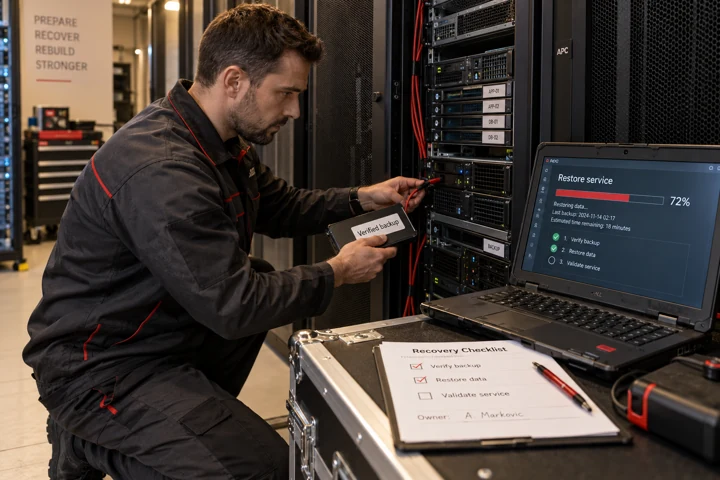
Data is not automatically safe because it is in the cloud or because it is stored locally. It is safe only when the company knows where it is, who can access it, how it is backed up and how quickly it can be restored.
Backup, recovery and business continuity must be designed as part of hybrid architecture, not added later as a separate technical task.
How to recognize unmanaged hybrid IT
There are clear signals that hybrid IT is not under control. The first is uncertainty about where data lives. If employees do not know whether the valid document is in the cloud, a local folder, email or another tool, the system already creates operational risk. The second signal is inconsistent access rules across teams. The third is lack of a unified cost view.
Another warning sign is dependence on a few people who understand how everything is connected. If only one administrator or one employee knows where things are and how problems are solved, the company does not have a system. It has dependency.
These issues are not solved by buying another tool. They are solved by mapping architecture, defining ownership, aligning rules and establishing regular monitoring.
Management responsibility
Management does not need to know every technical setting, but it must know what is critical, what must be protected and what level of risk is acceptable. If these questions are not answered at the business level, IT decisions are made only from a technical perspective.
A hybrid model needs governance: who approves new services, who decides where data is stored, who monitors cost, who owns access rights, who checks backup and who measures availability. Without that structure, hybrid IT remains a collection of tools rather than a managed system.
When governance is clear, IT can support business goals instead of constantly reacting to exceptions.
The operating model behind hybrid IT
Hybrid IT requires an operating model, not only architecture diagrams. The company needs routines for reviewing users, permissions, cost, performance, backup status and security incidents. If nobody reviews the system regularly, the environment slowly becomes harder to control.
This operating model should be simple enough to be used. Monthly infrastructure reviews, access reviews after role changes, documented backup tests and clear escalation paths can prevent many problems before they become incidents.
For management, the key is not to receive every technical detail. The key is to receive the right indicators: availability, major risks, cost trends, unresolved issues and projects that depend on infrastructure readiness.
Hybrid IT and future digital initiatives
Hybrid IT also affects future initiatives. AI assistants, analytics, automation and integrated business platforms depend on stable access to data and systems. If the infrastructure is fragmented, every new digital project starts by solving old technical debt.
A well-designed hybrid model creates a bridge between today’s reality and future modernization. It allows the company to move gradually while still improving control, security and user experience.
Positive approach
Positive helps companies treat hybrid IT as part of a wider business ecosystem. The goal is not cloud at any cost or local systems at any cost. The goal is an infrastructure model that supports security, continuity, productivity and growth. If your systems are already split across cloud and local environments, start with architecture before adding another tool.
Related services: CoreTech IT infrastructure