In this article8 sections
Time is often lost where management does not look first
When a company says it does not have enough time, the usual assumption is that people are not productive enough or that more employees are needed. In practice, the problem is often different. Time is not lost because people are not working. It is lost because the work system constantly forces them to search for information, check status, repeat tasks, wait for others and manually connect parts of work that should already be connected by the system.
This is why the question where companies lose the most time is not a question of personal discipline. It is a question of how work is organized. If employees work across too many tools, if agreements live in messages, if deadlines are tracked manually, if reports are built from several sources and if the same data is requested again and again, the company has a hidden operational cost.
That cost rarely appears on a single invoice. It appears through delays, loss of focus, employee fatigue, slower decisions and client frustration. Positive therefore sees lost time as a system symptom, not as an individual weakness.
The first loss zone: searching for information
One of the biggest sources of lost time is the search for information. Where is the latest version of the document? Who promised to reply to the client? What was agreed at the meeting? Where is the offer? Who has access to the data? When employees ask these questions every day, the company is not losing minutes. It is losing continuity.
This problem is common in companies that use email, chat, local folders, separate spreadsheets and informal agreements as the main work system. The information may exist, but it is not easy to find, ownership is unclear and the latest version is uncertain. People are no longer doing the work. They are looking for where the work is.
The solution is not just another tool. The solution is information centralization, clear rules about where things live and connecting knowledge with processes. This may include business software, document management, CRM, ticketing, project systems or an AI assistant that searches a controlled knowledge base. But first, the company needs to know which information is critical for work.
The second loss zone: invisible status
A lot of time goes into the question: where are we now? When status is not visible, people send messages, call colleagues, ask for confirmation and check whether something has been done. This creates pressure and interruptions. Even worse, management often sees the situation only when the problem is already late.
Invisible status is common in sales, support, projects, administration, procurement and internal requests. If there is no clear place that shows who is responsible, what the next step is and what the deadline is, the process depends on memory and individual discipline.
The solution is clear workflow. Every request, task or project should have status, owner, deadline, history and next step. When the system shows this automatically, there is less need for manual checking and constant interruptions. This is one of the fastest everyday benefits of digital solutions.
The third loss zone: manual copying and duplicate data entry
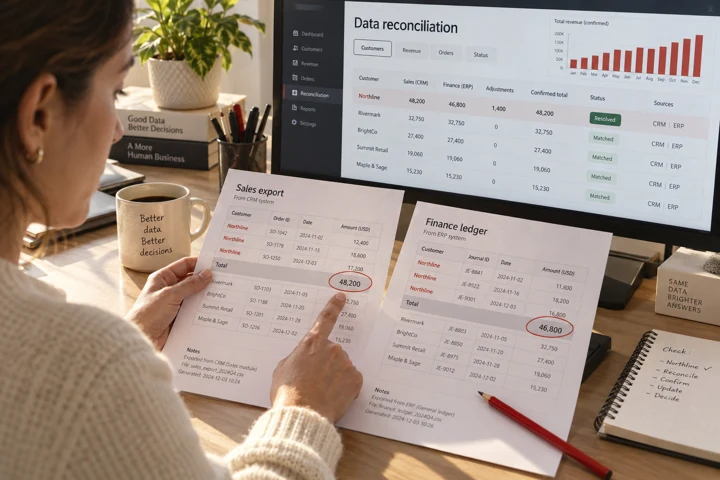
If employees copy data from email to a spreadsheet, from the spreadsheet to a system, from the system to a report and then again into a presentation, the company has a measurable problem. Manual entry is slow, boring and risky. Every additional entry increases the chance of error and reduces trust in data.
This usually happens when systems do not communicate or when the process has not been designed end to end. A company may have CRM, ERP, spreadsheets, email and documents, but no unified flow of information. Employees then become the bridge between systems. That is an expensive and unreliable bridge.
The solution may be integration, an automated workflow, better data entry at the source or AI support for processing unstructured information. But the principle remains the same: data should be entered once, in the right place, and then used across the system.
The fourth loss zone: meetings without outcomes
Meetings are necessary, but many meetings do not produce a decision, task or clear next step. People spend an hour talking, and after the meeting it is still unclear who does what, by when and based on which decision. In that case, the meeting does not solve the problem. It postpones it.
The loss is not only the meeting time. The loss is in preparation, repeated explanations, follow-up clarification and missed obligations. If notes are not structured, decisions are not recorded and tasks do not enter a system, the meeting remains an isolated event.
The solution is meeting discipline: agenda, decisions, owners, deadlines, minutes and connection with tasks. AI can help with transcript, summary and task suggestions, but the system still needs to know where those tasks live and who follows them.
The fifth loss zone: waiting for decisions
Companies often lose time because decisions wait for data, confirmation or people who are not currently available. If management has poor visibility, reports are late and information is not current, decisions move slowly. This slows sales, projects, procurement, support and development.
Waiting for decisions is often described as caution. In reality, it can be the consequence of poor information flow. When data is scattered and unreliable, people postpone decisions because they do not want to make mistakes. That is understandable, but expensive.
The solution is better business analytics, clear KPIs and data availability at the moment of decision. Business analytics should not be a monthly report created only to be archived. It should be a tool for faster and safer management.
How to identify time losses in your own company
The fastest way is to track repeated questions and interruptions for one or two weeks. What do people search for most often? Which information is repeated? Where is the most waiting? Which reports are manual? Which mistakes repeat? Which process depends on the same person again and again?
This analysis does not need to be complicated. Choose several teams, write down the most common operational delays and estimate how often they happen. When frequency is multiplied by the number of people and time lost, the hidden cost becomes much clearer.
Only then does it make sense to discuss the solution. Sometimes the answer is a better process. Sometimes software. Sometimes an AI assistant. Sometimes integration. Very often it is a combination. The key is that technology follows the real problem, not the other way around.
Time is recovered through systems, not pressure
Companies cannot solve lost time in the long term by simply asking people to work faster. If the system is disorganized, individual speed has a limit. Real improvement happens when unnecessary interruptions, manual steps, waiting and unclear status are removed.
If you want to find where your company loses the most time, start with processes that repeat every day. That is usually where the biggest opportunity lies for business automation, better work organization and clearer management.
Related services: business consulting
Frequently asked questions
Where do companies lose the most time?
Most time is lost in searching for information, checking status, manual data entry, meetings without outcomes, waiting for decisions and repeating the same operational questions.
How can hidden time loss be measured?
Track repeated interruptions, manual steps and waiting for one or two weeks. Then estimate how often they happen and how many people are involved.
Is lost time mostly a people problem or a system problem?
It is usually a system problem. People can be disciplined, but if information is unavailable, status is unclear and processes are not defined, time will still be lost.
What is the fastest way to reduce lost time?
The fastest wins are usually reducing manual status checks, information search and duplicate data entry. These processes repeat often and are easy to measure.
Can AI help reduce time loss?
Yes, especially in knowledge search, summaries, document processing and repeated questions. AI works best when processes and data are sufficiently organized.