In this article11 sections
Artificial intelligence can support organisations across many industries, but its actual value depends on the business problem, data quality, permissions and how people verify results. An assistant designed for customer service does not have the same responsibilities as one used in e-commerce, a healthcare institution or internal employee support.
Positive's original article “Primeri primene Positive AI” described six use-case areas: customer service, e-commerce, banking and finance, healthcare, marketing and internal support. This restored English edition follows that original structure while adding clearer practical requirements, limitations and measurement guidance.
Editorial note, October 2026: The 2025 article described percentage improvements in several industry examples without publicly available methodology, baselines or independently verifiable case studies. The examples below are therefore presented as possible application scenarios, not verified Positive client outcomes. A Positive LinkedIn republication is dated 22 May 2025; the precise original website publication date has not been confirmed.
1. Customer service — useful answers and a proper handoff
An AI assistant can support routine customer enquiries across a company website or approved messaging channels: opening hours, service scope, common procedures and where to find relevant documentation. An automated reply may be available outside working hours, but this does not imply that a human service team is staffed 24/7.
Example workflow: a user asks for an update on a support case. If appropriate authentication and a secure integration exist, the assistant can retrieve a permitted status. If the problem needs professional judgment, it gathers useful context and transfers the request to an employee without forcing the customer to repeat everything.
Controls include an approved knowledge base, explicit handoff rules, access restrictions and suitable privacy notices. Measure confirmed resolution of simple requests, answer accuracy and time to human intervention.
Our related article, An AI Chatbot Is More Than a Website Widget, explains how this fits into business operations.
2. E-commerce — helping customers choose and track orders
In online retail, an assistant can help shoppers navigate a catalogue, compare supported product features, understand delivery terms and find return information. Recommendations need current, reliable product data. The assistant must not invent a price, stock level or warranty.
Example workflow: a shopper describes intended use, budget and compatibility requirements. The assistant searches an approved product catalogue, suggests a small number of relevant options, explains the differences and links to actual product pages. Order information should be exposed only through appropriate authentication and access control.
Personalisation requires additional care. Responding to an anonymous list of preferences is different from accessing a named customer's purchase history. Privacy obligations and permissions need to be considered before enabling the latter.
Useful metrics include successful product discovery, repeated enquiries and meaningful progression to checkout. Conversion rates can be informative, but observed changes should not automatically be attributed to the assistant without a defensible comparison.
3. Banking and finance — accurate information without unauthorised decisions
Financial institutions may use AI assistants to explain approved public information about products, required documents, office hours or the stages of a standard application. Where policy permits, authenticated users might also check the status of an existing request.
Example workflow: someone asks which documents are required for a particular service. The assistant retrieves current approved guidance and makes the source clear. Where the matter depends on a customer's individual circumstances, it provides a route to an authorised professional.
Sensitive operations, such as reading account balances, changing personal information or initiating payments, require strong controls. A generated response cannot replace authorisation by the bank's systems. The assistant should not offer unreviewed personalised financial advice.
Evaluate factual accuracy, successful completion of information-seeking tasks and the speed of escalation. In a regulated environment, safety and trust outweigh the raw count of automated conversations.
4. Healthcare — administrative guidance and appointment support
Healthcare organisations can use AI for administrative questions: service availability, preparation instructions, scheduling information and appointment reminders. These functions are distinct from medical diagnosis or prescribing treatment.
Example workflow: a patient asks about appointment times. The assistant displays approved options or starts a controlled booking process. If the conversation reveals urgent symptoms or a medical question, the system should route the person to an appropriate clinical channel rather than present itself as a clinician.
Health information is sensitive. A deployment should distinguish public service information from personal records and enforce appropriate legal bases, confidentiality, permissions and retention controls.
Success can be assessed through administrative accuracy, fewer repeated booking steps and patient experience. Efficiency should never be pursued at the cost of inappropriate handling of health information.
5. Marketing — qualifying interest and supporting the team
A marketing assistant may clarify an offer, help visitors identify the right service, prepare draft campaign copy for human review or collect structured enquiries with appropriate notice. The same technology can help employees organise content ideas and produce variations from approved facts.
Example workflow: someone asks about an AI chatbot for a business. Instead of presenting generic sales slogans, the assistant asks which channels are used, how many requests are handled, what systems are already in place and what improvement is needed. It then points to a relevant resource or offers a consultation.
Avoid unsupported superlatives, invented case studies and intrusive personalisation. Good marketing assistants should work from approved information, respect the brand voice and clearly separate assumptions from facts.
Track the completeness and relevance of enquiries, response quality and progression to a legitimate next step. Conversation count alone does not measure business value. See AI Marketing Assistant: Save Time With Better Workflows for related practical guidance.
6. Internal support — knowledge, procedures and routine administration
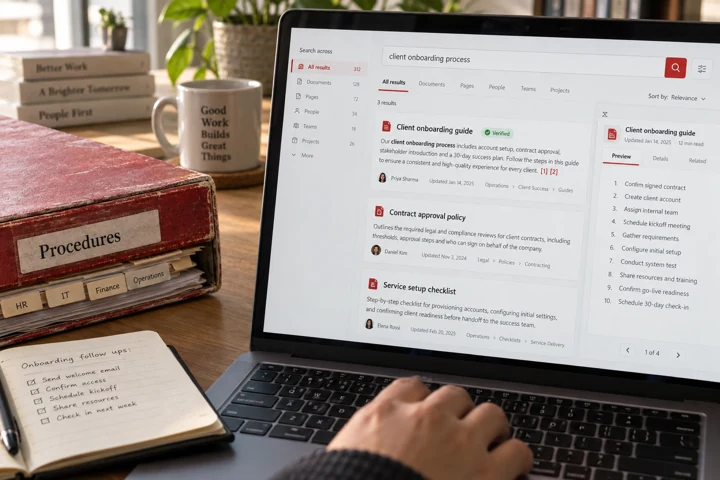
An internal assistant can help employees find current procedures, forms, operating instructions and answers to recurring workplace questions. It may also draft a service request or report for review, provided access permissions and responsibility are clear.
Example workflow: an employee asks how to report an IT issue or where to find the relevant policy. The assistant retrieves an approved instruction, identifies the necessary form and, if authorised, prepares a ticket. It must not reveal payroll or personnel records that the employee is not allowed to access.
There is an important distinction between finding information and performing actions. An assistant may explain how approval works without having permission to approve spending, grant system access or send confidential files.
Possible measurements include time to find a correct instruction, accuracy of cited sources and the number of requests that no longer need manual routing. None of these benefits are reliable without maintained documentation.
What foundations do AI assistants share across industries?
The applications differ, but many foundations are similar. A system should recognise the task, obtain permitted information, deliver a useful answer and involve a person when confidence or authorisation is insufficient.
Approved website pages, operational procedures, product catalogues and carefully maintained FAQs can serve as sources. Retrieval-augmented generation (RAG) can help applications supply relevant, up-to-date passages without retraining the underlying model for every revision, but retrieval does not itself guarantee accuracy.
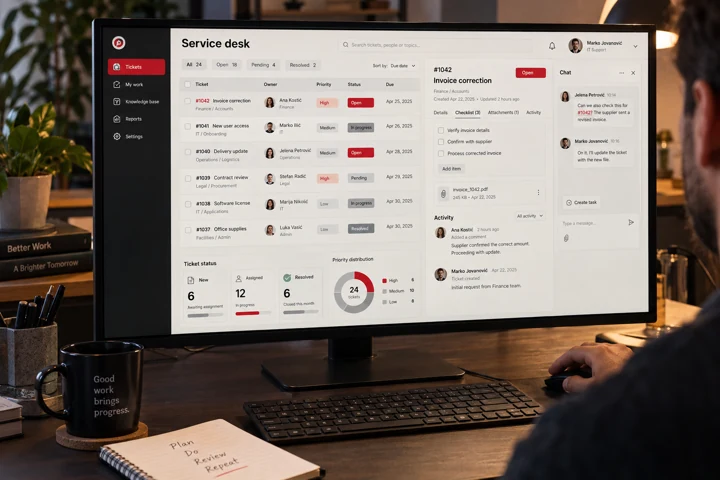
CRM, ticketing or operational-system integrations must enforce authorisation in the application. A model's statement that an action is approved is not evidence of permission. The service needs independent checks, narrow scopes and appropriate logging.
How is a real deployment different from a demo?
A demonstration may show one successful conversation. A production service must handle incomplete questions, outdated sources, failed integrations, unexpected requests and attempts to manipulate instructions. It also requires a plan for monitoring and improving unsuccessful answers.
For each use case, document what the assistant can do, which information it can access, who maintains its knowledge and how a user reaches a human. Build a test set of representative conversations, including ambiguous and adversarial examples.
The NIST AI Risk Management Framework can support governance and evaluation, while OWASP guidance identifies security risks associated with language-model applications, including prompt injection and excessive permissions.
How to measure value without invented percentages
Before deploying an assistant, record the baseline: request categories, time to a correct answer, repeat contacts, handling effort and error rates. During a pilot, measure comparable tasks using the same definitions.
When assessing return on investment, include staff review time, knowledge-base maintenance, security controls, integrations, training and any additional work caused by errors. A count of conversations does not prove that customer issues were resolved.
The original article included several numerical improvement examples. Because their methodology and independent verification are unavailable, we do not present those percentages as demonstrated results. Evaluate every real deployment against its own baseline and a transparent measurement plan.
Where does this sit within the Positive ecosystem?
Positive historically used the Positive AI name for specialised assistants and chatbots. Within today's ecosystem, dedicated AI services are developed through Cybercompany, while connected business workflows may also involve the organisation's software and IT infrastructure.
What matters to a customer is not the name of the assistant but the workflow it improves, the sources it uses and who is accountable for the result. Customer service, sales, administration and internal knowledge should not all be assumed to require the same design or level of autonomy.
Explore Cybercompany's AI services in the Positive ecosystem or contact Positive to discuss a specific use case. Start with the process and safeguards, not another website chat widget.
Conclusion — the best use cases are measurable workflows
The original six areas illustrate where AI assistants can be relevant: customer questions, shopping journeys, financial and healthcare administration, marketing and employee support. Each involves different information, permissions and operational accountability.
The value of the Positive AI approach is not providing an identical chatbot to every industry. It is implementing a carefully scoped tool that delivers a verifiable improvement for a defined task, remains safe to operate and allows people to intervene when necessary.
Frequently asked questions
What are the main Positive AI use-case areas?
The original article covers customer support, e-commerce, banking and finance, healthcare, marketing and internal support. Each requires task-specific design and safeguards.
Are these examples verified client results?
They are not presented as verified results. The original article contained percentage claims without publicly available methodology or independent evidence; this edition treats them as historical illustrations.
What can a customer-service AI chatbot do?
It can answer common questions using approved information, help categorise requests and hand complex cases to employees with suitable data safeguards.
Can an AI assistant give financial or medical advice?
A general assistant should not replace authorised financial or medical professionals. Sensitive and regulated cases require additional validation, safeguards and professional oversight.
How does an AI assistant connect to business systems?
Through controlled integrations with approved sources and services such as CRM or ticketing, with independent identity checks, authorisation and appropriate action logging.
How do you measure AI assistant impact?
Establish a baseline and measure accuracy, completed tasks, response time, corrections and full operating costs. Message volume alone does not establish business value.