In this article16 sections
What do an individual's life, swimming and running a company have in common? In the original personal essay “Život i biznis: Lekcije iz vode”, water symbolises an environment that keeps changing. At times it carries us forward; at times it resists us; sometimes it becomes so murky that we must change direction. The message is not to swim faster than everyone else. It is to learn how to stay above the surface, help the people swimming alongside us and preserve the conditions in which progress is possible.
Editorial note (October 2026): This is a reconstructed and substantially expanded editorial edition of the personal essay “Život i biznis: Lekcije iz vode”, originally published on 7 March 2025 by Miljan Radanović in the Business category. It retains the original motifs of balance, continued movement, changing water temperature and currents, learning swimming technique, fins and goggles, leaving polluted water, supporting fellow swimmers, and applying the metaphor to people, processes, data, AI, business software and cybersecurity. New explanations and examples from 2026 are editorial additions, not verbatim statements written by the original author in 2025 and not accounts of specific customer projects.
Life and business: Why lessons from water still matter
When entering water, a person quickly discovers that movement depends on both their abilities and the conditions around them. A strong swimmer can still be surprised by a current. Someone may know the technique, but cold and exhaustion change the available options. Organisations are similar: experience, capital and strategy matter, yet market developments, relationships between people and unexpected problems can make a different pace necessary.
Water is a metaphor for the life of an organisation rather than a ready-made management formula. It offers a simple image for remembering that effort alone does not determine outcomes. Attention, discipline, judgement and the willingness to learn are also necessary. A resilient organisation does not deny environmental change. It learns to identify change early enough to respond with care and purpose.
Keeping your head above water: Movement and continuity
In water, stopping all movement can become dangerous. In business, repeating an established routine while customer needs are changing can also lead to decline. Yet continuous movement does not mean launching a new project every day. It may involve calmly maintaining service quality, reviewing existing work, fixing one persistent bottleneck or speaking with people who see problems first.
A company needs continuity: clarity about what matters today, who maintains core processes and which decisions cannot be postponed. During difficult periods, that discipline allows a team to avoid spending all its energy on an appearance of activity. Sustainable progress must preserve the organisation's basic ability to operate, serve customers and make considered choices.
Breathing and balance: Efficiency without losing stability
A swimmer must coordinate breathing, body position and movement. Spending every bit of energy in the first few metres can leave too little for the rest of the journey. Likewise, a company focused exclusively on sales growth while neglecting its people, cash flow or delivery quality becomes vulnerable. Balance is not passive stillness; it is the continual alignment of competing needs.
For leadership, this means considering growth alongside team capacity, customer confidence and systems reliability. Sometimes progress requires acceleration; sometimes it calls for removing unnecessary effort. A short, deliberate check of direction is not surrender. Like controlled breathing when swimming, it can make longer and more effective work possible.
Warm and cold water: Adapting to actual conditions
The original essay describes water that is not always at the temperature we would prefer. Businesses rarely receive perfectly comfortable conditions either. Markets change, regulations affect processes, customers expect different communication and suppliers alter prices or delivery times. Adapting does not necessarily require abandoning the goal. Often the appropriate response is to change how the goal will be reached.
Start by identifying what really changed rather than relying on impressions. Then speak with those who hold relevant information and test a contained response. Large transformations without a diagnosis can consume resources without improving outcomes. Learning to swim in varying water conditions resembles a series of sound adjustments more than a constant succession of grand strategic reinventions.
Fins, wetsuits and goggles: Tools that support the swimmer
In the historic comparison, the swimmer gradually obtains fins, a suit and goggles. Equipment can make swimming easier, but it does not swim on a person's behalf. For a business, similar tools might be effective business software, analytics, automation, reliable IT infrastructure or responsibly deployed artificial intelligence. They can extend a team's capabilities when selected for a clear purpose.
Buying software without defining the process is like adding equipment before a swimmer knows the destination. A better sequence is to understand the problem, choose the right instrument, train the people using it and measure the outcome. Technology is neither decoration nor proof of sophistication. Its value lies in reducing wasted effort and freeing people to focus on work that matters.
Swimming technique takes a lifetime: Learning and development
A swimming technique is not perfected in one lesson. Movements become more effective through experience, attention and feedback. The same holds for leadership and organisational development. Teams change, new colleagues bring different expectations and yesterday's experience does not guarantee a good answer to tomorrow's challenge. Learning should therefore be part of ordinary work rather than an occasional special event.
Practical activities include short project reviews, documenting what worked, regular training and knowledge sharing between colleagues. A particularly important ingredient is a culture where employees can point out weaknesses and suggest improvements. In such an environment, mistakes are not simply hidden. They become information that can help everyone work better next time.
Murky or polluted water: Knowing when to change the environment
Sometimes the problem is not the swimmer's skill but the water they are in. The source essay pays attention to the moments when the surrounding environment becomes harmful and staying may create further damage. In business, equivalents include a culture of blame, poor communication, opaque decision-making or processes that consume effort without contributing meaningful value.
Working harder on an individual level cannot always correct such conditions. The organisation may need to identify root causes, set boundaries and change responsibilities, priorities, relationships or ways of working. The point is not to escape every difficult challenge. It is to distinguish challenges that develop people and organisations from patterns that steadily undermine the ability to work well.
Swim freestyle when necessary, on your back when possible
The original distinguishes urgently leaving difficult water from more relaxed swimming when conditions allow. Business has comparable modes. When a security incident disrupts operations, people need focus, clear authority and rapid, responsible action. When systems are stable, organisations can invest more attention in planning, learning, relationships and the development of their teams.
Neither mode suits every situation. Teams stuck in permanent crisis response tend to burn out; teams that never react to emerging risks may ignore obvious warning signs. Good leadership can recognise when to accelerate and when to preserve energy for sustainable progress. Understanding the appropriate rhythm may be more valuable than insisting that every situation requires maximum speed.
Fellow swimmers: Responsibility for the people around us
We do not swim alone. Other people may provide support or create risk, depending on how we act together. In a company, colleagues, partners and customers occupy a shared environment. No software can substitute for trust if teams conceal information, fail to honour agreements or disregard each other's needs.
Community is not merely a slogan. It becomes visible when responsibilities are handed over clearly, problems are reported promptly, colleagues receive support and clients receive truthful explanations about what can and cannot be done. The success of one person or department has limited long-term value if the rest of the organisation loses its capacity to function. Responsible cooperation makes everyone's work more effective.
Keeping the water clean: Culture and shared conditions
Care for the water in the original metaphor also means care for the conditions shared by everyone. Inside a company, these conditions include working culture, transparency, information quality and mutual respect. If the environment becomes murky through conflicting priorities or unhelpful behaviour, more energy is spent working around obstacles and less goes into creating value.
A healthy environment is not created by publishing one policy. It emerges through leadership behaviour, clear processes and consistent decisions. People can perform better when they know whom to approach, how issues are resolved and what is expected of them. Protecting the water means caring for the common system, rather than defending one's own position at the expense of everyone else.
Rough water teaches us: Resilience without romanticising crisis
Difficult experiences can generate useful learning and expose limits that were previously invisible. That does not mean every stressful situation or business loss should be celebrated as an automatic benefit. Value appears when people reflect on the experience, remove weaknesses and change the conditions that caused unnecessary damage.
After an incident or an unsuccessful project, useful questions include what the team knew, which signals it missed and what would help identify a similar problem earlier. Resilience then becomes a set of real capabilities: alternatives, reliable colleagues, accurate information and a willingness to respond differently. Merely surviving one crisis does not demonstrate that an organisation has become more resilient.
Data as a compass: Finding the right direction
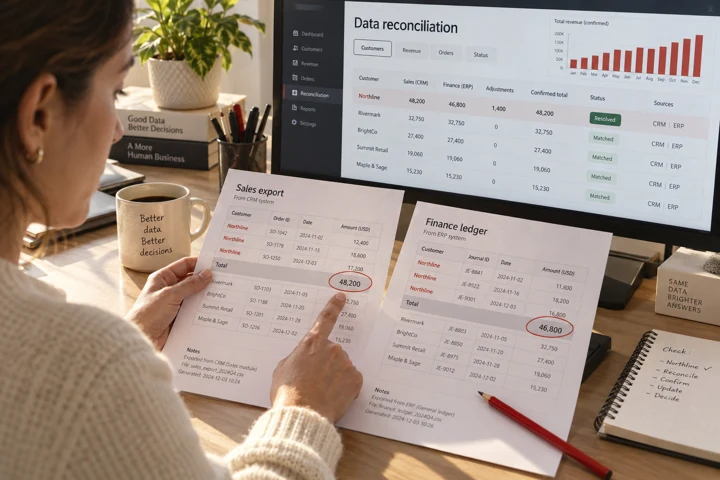
The original author connects water with business decisions and treats information as a compass. When conditions change quickly, a clear view of processes and a small set of meaningful metrics can be more useful than intuition alone. Data can reveal why deliveries are delayed, where requests accumulate or which activities use more time than expected.
Yet a compass does not choose the swimmer's destination, and a dashboard cannot take responsibility for management. Teams need to agree on what is measured, where information comes from and who interprets it. Artificial intelligence may help summarise or exploring material, but reliable insights depend on sound sources and human verification. The decision remains with the people who understand its consequences.
AI and business software as support, not substitutes for people
Business software can organise tasks, deadlines and collaboration, while AI may make information easier to retrieve and help draft appropriate responses. These are present-day examples of the fins and goggles from the source essay. In Positive's current ecosystem, ONE addresses operational business software while Cybercompany covers AI strategy, chatbots and assistants.
The right tool depends on the actual problem. If nobody knows who owns a task, adding an AI assistant will not automatically solve unclear accountability. If data is scattered and unreliable, the information foundation may need attention first. Technology is most useful when it supports a shared objective, clear responsibilities and workable processes, rather than concealing their absence.
Cybersecurity as protection in rough water
The original essay also relates unpredictable business conditions to protecting systems and information. In practice, this means managing identities and devices, updating software, maintaining recovery copies and preparing for incidents. Data loss or service disruption can halt progress even when a company has a promising idea and a committed team.
CoreTech represents the IT infrastructure, support and cybersecurity direction within Positive's current ecosystem. Whatever provider an organisation selects, security needs to reflect business priorities and realistic recovery arrangements. The objective is not to promise that waves will never come. It is to develop the ability to notice, contain and recover from problems with less damage to people and operations.
A company as a living organism: People matter most
One of the central messages of the source essay is that companies grow and function through people. Processes, data and technology can support them, but people design, maintain and use those systems. A healthy organisation therefore needs to understand how decisions travel, how knowledge is shared and how teams cooperate when events do not follow the plan.
Productivity should not be reduced to a count of completed tasks. People have limited time, concentration and energy. A business system works well when it enables quality work without constantly wasting strength on confusion and avoidable friction. Sustainable balance appears when knowledge, organisation and innovation are brought together in a coherent way.
Keep swimming, but know why
The water metaphor does not provide an effortless recipe for success. Instead, it raises important questions. Are we moving in a useful direction? Do we understand the surrounding conditions? Are our tools genuinely helpful? Do we look after the people sharing our work? Can we recognise the moment to change our technique or even leave an unhealthy environment?
The original essay concludes by connecting experience and challenges with Positive's role as a strategic partner. In contemporary practice, this means first understanding how a company operates and only then considering specific tools and services. Possible areas include business strategy, software, AI and a stable IT foundation, but not every company requires all of them. Explore the Positive ecosystem or contact us to discuss a suitable approach. The goal is to keep moving without losing our sense of direction or our responsibility for the people swimming beside us.
Related service: Contact Positive.
Frequently asked questions
What is the central message of Life and Business: Lessons From Water?
Like swimming, running a company requires continuing movement, balance, adapting to conditions and caring for others.
Who wrote the original article and when was it published?
The original personal essay was written by Miljan Radanović and published on 7 March 2025 in Positive's Business category.
What do fins, a suit and goggles represent?
They represent learned skills and supportive tools, such as effective work practices, software, analytics and responsible AI use.
Why does the essay describe murky or polluted water?
To illustrate the importance of recognising harmful conditions and changing business environments, processes or relationships that prevent healthy progress.
What role do data and technology play in this metaphor?
Data act as a compass and technology as swimming equipment. Neither replaces human judgement, responsibility or a clear direction.
How does Positive connect this idea to its current ecosystem?
By understanding actual processes before considering business strategy, ONE software, Cybercompany AI or CoreTech infrastructure where those address a real need.