In this article13 sections
IT solutions for business are not simply computers, servers and software licences. They connect workflows, customer relationships, data and technology infrastructure so an organisation can operate reliably and grow without adding unnecessary complexity. The right solution depends on concrete needs: where employees lose time, which information is missing, how sales activity is tracked and whether important services can withstand disruption.
Positive's original article “IT Solutions for Business”, published on 10 February 2025, explored four core areas: CRM platforms, cloud services, business analytics and cybersecurity. This restored edition preserves that original structure while explaining how these elements can work together, how to prioritise investments and how to assess outcomes without unrealistic promises.
What are IT solutions for business?
A business IT solution combines technology, implementation, ownership and working practices to solve an operational problem. It might be a CRM for customer relationships, a project and ticketing system, an accessible cloud environment, an analytics platform or professional management of business infrastructure.
The value is not the number of applications installed. It is whether teams can obtain reliable information, customers receive timely responses, leaders can make decisions and essential systems remain available. Product selection should follow a clear understanding of the problem, not precede it.
The four areas from the original article are linked. CRM creates structured information about customers; analytics turns reliable records into insight; cloud infrastructure can support access and capacity; and cybersecurity and maintenance protect business continuity.
1. CRM: managing long-term customer relationships
Customer Relationship Management (CRM) software organises contacts, companies, opportunities and follow-up activities. Its purpose is not simply to hold a large contact list. It provides a shared view of customer relationships that does not depend on one employee's email account.
A CRM can register an enquiry, assign responsibility, remind staff of the next contact and show the stage of a sales opportunity. For teams working with the same customer, shared activity history reduces duplicate effort, missed requests and inconsistent quotations.
Before adopting a CRM, define the process: what counts as a qualified enquiry, which stages are used, who maintains information and when records must be reviewed. Without those rules, a CRM can become another disorganised database.
In the Positive ecosystem, ONE addresses business software needs including CRM, projects, tasks and ticketing. See ONE business software and our article about connecting CRM, projects and reporting.
2. Cloud services: flexibility with clear responsibilities
Cloud computing makes infrastructure, applications or data storage available through a service provider. It can help organisations work across locations and adapt capacity as requirements change. But cloud is not automatically cheaper, simpler or more secure for every workload.
Evaluation should cover consumption and data transfer costs, dependence on internet connectivity, application requirements, permissions and recovery capability. Cloud file synchronisation is not the same as an independently recoverable backup; deletion or corruption may be synchronised across devices.
A hybrid model may be more practical than moving everything at once. Some services can remain on premises while others use cloud resources. The choice should reflect business needs, the type of data handled, available skills and the degree of control required.
See When a Cloud Migration Makes Sense. CoreTech supports infrastructure operations, including cloud management activities such as CloudOps within the Positive ecosystem.
3. Business analytics and BI: turning records into decisions
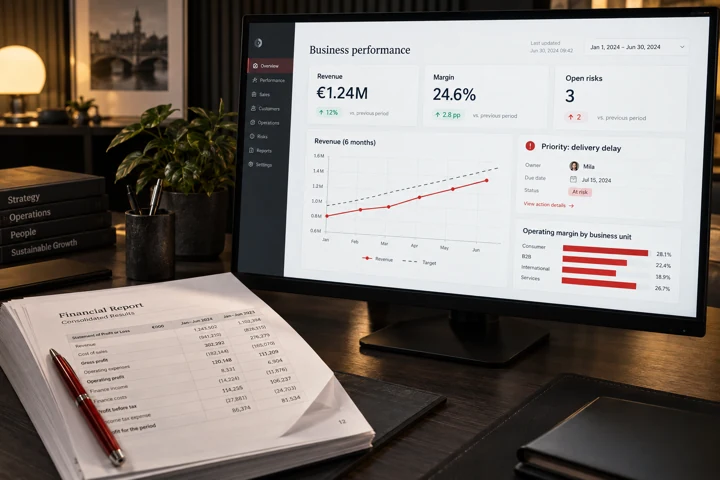
Business Intelligence (BI) encompasses collecting, connecting, analysing and presenting data to support business decisions. A revenue chart is not enough if management cannot understand what caused a change, which activity it represents or who should respond.
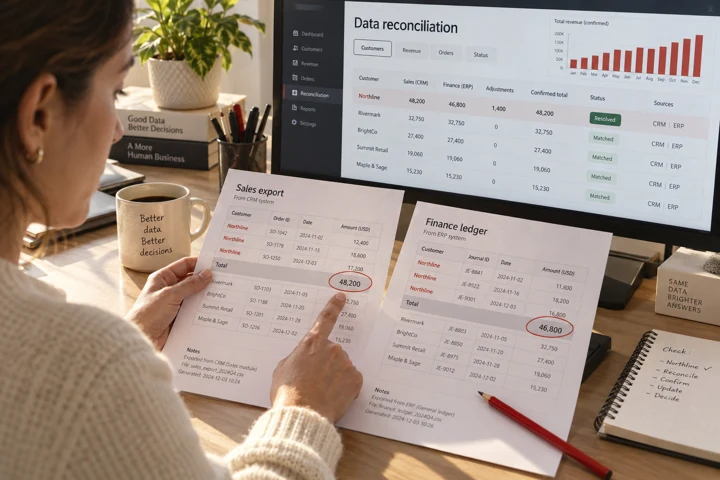
BI solutions can bring together metrics from sales, finance, operations and support, provided those metrics have consistent definitions. Terms such as “active customer”, “revenue” or “completed project” should not mean something different in every department.
A dashboard can make trends and exceptions visible, but it cannot correct poor source data on its own. Assign responsibility for metrics, maintain reliable sources and establish a process for resolving conflicting numbers.
Begin with a small group of indicators tied to real management decisions. Five dependable KPIs can be more useful than fifty attractive graphs that nobody acts on.
4. Cybersecurity: protecting data and continuity
Cybersecurity protects business devices, accounts, networks, applications and information. The original article discussed antivirus protection, firewalls, encryption and intrusion detection. Those measures remain important, but a complete programme also needs access management, patching, recoverable backups, monitoring and incident response.
Begin by identifying administrative accounts and critical systems. Enable MFA for important access, maintain supported software, keep endpoint protection visible and periodically test actual data restoration. Alerts need an owner and a response plan.
NIST Cybersecurity Framework 2.0 structures cyber risk management around governing, identifying, protecting, detecting, responding and recovering. It is a practical reminder that security is a continuing management responsibility, not a one-time product purchase.
For details read IT System Security for Business. Within Positive, CoreTech focuses on infrastructure, security and continuity.
5. Infrastructure and IT support: a foundation for reliability
CRM, cloud services and BI cannot provide their intended benefits if employees frequently lose access to networks, devices or critical applications. Business IT solutions depend on infrastructure that is correctly designed, maintained and understood.
Inventory servers, workstations, network equipment, identities and important applications. For each essential component, define ownership, maintenance responsibilities, availability expectations and the response to failure. A forgotten device or inaccessible administrator account can create more disruption than the absence of a new platform.
Proactive IT management includes planned maintenance, health monitoring, alert triage and user support. CoreTech's approach is organised around stable, available and secure operations rather than only reacting after equipment fails.
How do CRM, cloud, BI and security work together?
Imagine a company where a customer enquiry is registered in CRM, a team member receives a task, approved documents are available to authorised employees and management can track response times and service quality. Business software, infrastructure and analytics then support one connected workflow.
The goal does not necessarily require every record to live in a single application. Systems can exchange selected data through controlled integrations, provided there are reliable identifiers and clear ownership of synchronisation, updates and error handling.
Permissions matter. Connecting two services must not grant every user access to all the information in both. Integration without data governance may cause more confusion and risk than the spreadsheets it was intended to replace.
How should a small or medium-sized business choose IT solutions?
Begin with the most disruptive business problem. If sales enquiries are routinely lost, investigate CRM. If documents are unavailable across locations, review access and cloud options. If leaders cannot obtain consistent figures, address data quality and analytics. If the network regularly fails, infrastructure and support should come first.
Next, consider readiness. Does the organisation have process owners, documented workflows, an inventory of important technology and staff who can adopt the change? Not every product makes sense at every stage of growth.
Prefer solutions that can be supported, connected and exited without losing control of company information. Ask vendors or partners to define responsibilities, service limits, support expectations and what is not included.
The real cost of business IT solutions
A monthly subscription or purchase price is only one part of the total cost. Implementation, data migration, integrations, training, account administration, support, monitoring, backup and disruption during the transition all need consideration.
Cloud services may reduce certain up-front purchases while adding consumption-based recurring charges. On-premises hardware has a different cost profile involving acquisition, maintenance, replacement and operational responsibility.
For CRM, data-entry discipline and adoption have costs. In analytics, cleaning and standardising data can require more work than configuring the dashboard. Evaluate the complete financial and operational picture rather than a promoted monthly price alone.
Implementation without unnecessary disruption
A phased approach is usually more manageable. Map the current workflow, gather requirements and define the desired result. Pilot a limited scope with real users and representative records, then plan wider deployment once the process is reliable.
Before migration, verify data export, backups, user access, training and a rollback approach if something goes wrong. Involve people who will use the system daily, because they know where the practical difficulties occur.
Do not evaluate success only by the go-live date. Adoption, information quality, dependable operation and the ability to produce the required business result are what matter.
Measuring the value of deployed IT solutions
For CRM, measure enquiry completeness, response times and the percentage of opportunities with a defined next step. For cloud, consider availability, recurring costs, recovery times and user experience. For BI, assess how quickly management receives trustworthy information and whether it helps inform actual decisions.
For infrastructure, measure downtime, incident resolution, backup recovery tests and maintenance coverage. For cybersecurity, track concrete controls rather than a claim that all risk has been removed.
Metrics only tell a useful story when there is a baseline. Review results over time and include the work needed to maintain them. This helps distinguish measurable improvement from presenting the same situation in a newer interface.
Where does the Positive ecosystem fit?
Positive connects three complementary areas: business software, IT infrastructure and applied artificial intelligence. The two most relevant to this guide are ONE, supporting organised work through CRM, projects, tasks and ticketing, and CoreTech, covering infrastructure reliability, IT management, cloud operations and cybersecurity.
The third area, Cybercompany, can become relevant after workflows and data are organised and the business is ready to test whether AI adds meaningful value. Starting with advanced technology is not helpful when basic records or ownership remain unclear.
The right conversation therefore begins with the business problem: where time is lost, what threatens continuity, which facts are missing and who will be accountable for the result.
Conclusion: IT solutions are a means to business growth
CRM, cloud, business analytics and cybersecurity remain the four core areas highlighted in Positive's original article. Their greatest value emerges when they are supported by coherent processes, reliable infrastructure and people who understand how to use the system.
A company does not need to implement everything at once. Assess the current environment, select the most important bottleneck and agree on measurable outcomes before purchasing new technology. To discuss how business software and infrastructure could work together, schedule a conversation.
Frequently asked questions
What do business IT solutions include?
They include business software such as CRM, cloud services, analytics, cybersecurity, infrastructure and support. The appropriate combination depends on business goals and workflows.
Does every business need a CRM and cloud services?
Not in the same form or scope. CRM can improve customer-related workflows and cloud can support access and capacity, but business needs and costs should be assessed first.
What is the difference between CRM and BI?
CRM manages customer relationships and activities, while BI combines and analyses data from different sources to support decisions. They can integrate but serve different primary purposes.
Does cloud automatically reduce IT costs?
No. Cost depends on usage, storage, data transfer, support, availability and safeguards. Compare the total cost of viable deployment models.
What cybersecurity measures should a business prioritise?
Asset and account inventories, MFA, software updates, endpoint protection, tested recoverable backups and a clear incident response plan.
How should the value of a business IT solution be measured?
Compare before-and-after results for task times, data quality, missed enquiries, service availability, operating costs and customer outcomes.