In this article8 sections
Featured snippet: CRM, projects and reporting should be connected because sales, delivery and management do not operate as separate worlds. When the CRM system, project work and reporting work together, the company sees the full flow from opportunity to delivery and business result.
Three separate systems create three different views of the business
In many companies, sales, operations and management work in separate systems. Sales tracks opportunities in a CRM or spreadsheets. Operations manages projects in another tool. Management receives reports in a third format, often manually prepared before meetings. Each part may function on its own, but the company does not have one connected picture.
This problem is not obvious at the beginning. When the number of clients and projects is small, people can manually bridge the gaps. A salesperson asks the project team for status. A manager requests a report from finance. A director receives a verbal explanation. As work grows, manual connection becomes slow, unreliable and expensive.
That is why the CRM system should not be treated as an isolated sales tool. It is the beginning of a business flow. If it is not connected to projects, tasks, delivery and reporting, management sees only the start of the story, not its real outcome.
CRM is the entry point, not the entire operating system
A good CRM helps the company see contacts, opportunities, communication, sales stages and probability of closing. That matters because without a structured sales flow the company does not know what is coming. The problem starts when a deal is closed and then disappears from management visibility.
At that point, delivery begins. Who takes over the client? Who opens the project? Who defines tasks? How are deadlines tracked? Is the scope of work the same as what was sold? If CRM is not connected to projects, the company can easily lose continuity between promise and delivery.
Sales and operations must be connected. Not because everyone should see everything, but because the business flow must be clear. When digital solutions connect commercial and operational work, the risk of misalignment is reduced.
Projects show whether promises become results
The project layer shows what happens after the sale. It reveals who is working, what is late, where blockers appear, which resources are overloaded and whether delivery stays within the agreed scope. Without this layer, CRM provides a commercial view but not operational truth.
Good project management is not just a list of tasks. It is the way a promise made to the client becomes concrete work. Each project needs an owner, deadlines, statuses, tasks, dependencies, risks and clear communication.
Connecting CRM and projects makes the full flow visible: from lead to offer to delivery. This is especially important for companies that sell complex services, implementation work, IT projects, consulting or any activity where delivery lasts longer than a single transaction.
Reporting should be a result of work, not an additional job
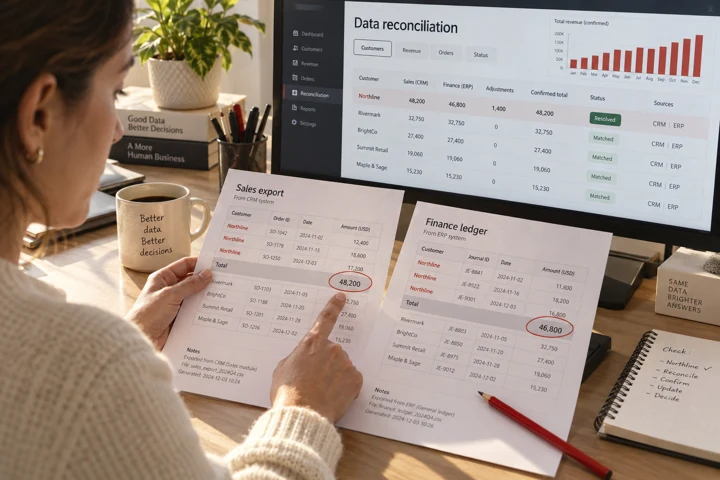
When CRM and projects are not connected, reporting becomes manual labor. People collect data from different sources, check versions, compare statuses and prepare presentations. Management eventually receives a report, but often late and after significant effort.
A better system works differently. Data is created during normal work: in sales, projects, tasks, tickets and client communication. Reporting is then built from that data. The BI platform is no longer a manual decoration layer, but a way to see the real business flow.
Reporting must be connected to ownership. If the dashboard shows delay, it should be clear who owns the next action. If opportunities grow, delivery capacity must be visible. If profitability changes, management should understand which processes influence it.
What a connected operating system looks like
A connected system does not always mean everything must live in one tool. Sometimes one integrated platform is best. Sometimes several tools connected properly are the right solution. What matters is that the business flow is clear and data does not live in isolated islands.
A mature flow may look like this: an opportunity enters the CRM, moves through defined stages, becomes a project after closing, tasks are created, the team receives responsibilities, statuses update through work and management sees reporting without manual assembly.
This is the value of an integrated operating platform: CRM, tasks, projects, tickets, documents, time, reporting and communication connected into one working logic.
How to start without unnecessary risk
The best approach is not to connect everything at once. Start with one business flow that has visible impact. For example: opportunity to project, ticket to resolution, project to report or CRM to management dashboard.
Then define minimum rules: which stages are used, who owns each step, which data is mandatory, what is measured and which report management actually uses. Without this, integration can become a technical project with weak business value.
Positive approaches this gradually: business context and process first, tools and integrations second, automation and analytics after that. The goal is not more software. The goal is a clearer operating flow and better control over the work already being done.
Pitanja koja menadžment najčešće postavlja
Do CRM, projects and BI have to be in the same software?
Not always. What matters is that they are connected through process, data and ownership. One system can help, but integrations can also work well.
What is the biggest risk of separate tools?
The biggest risk is that sales, delivery and management look at different versions of the business and problems appear too late.
Where should a company start?
Start with one flow that has clear business impact, such as opportunity to project and management reporting.
Does connecting tools mean more employee surveillance?
It should not. The goal is clearer work, less manual coordination and better accountability, not control for its own sake.
How can Positive help?
Positive helps map the operating flow, define rules, choose tools, connect systems and create reporting management can actually use.
Sledeći korak za tim koji želi više kontrole
If your sales, projects and reporting currently live in separate worlds, it is time to connect them into one operating system. Book a consultation and define the first flow to improve.
Related services: business consulting