In this article8 sections
Featured snippet: Management makes better decisions when data is not scattered across spreadsheets, messages and isolated reports, but connected into a system that shows business status, trends, risks and ownership. Business analytics then becomes a management tool, not just a reporting layer.
The issue is rarely a lack of data
Most companies already have more data than they can comfortably use. Sales teams keep CRM records or spreadsheets, finance has its own reports, operations tracks projects, support manages tickets and marketing follows campaigns. The real problem is not that data does not exist. The problem is that data is scattered, inconsistent and often available only after the decision should already have been made.
This creates a familiar paradox: the company has many tools, many reports and many activities, but management still relies heavily on intuition, experience or the loudest opinion in the room. Intuition matters, especially when leaders understand the business deeply. But as the company grows, intuition cannot remain the primary management system.
The purpose of business analytics is not to create another attractive dashboard. Its purpose is to show what is really happening: where revenue is created, where time is lost, where processes slow down, which teams are overloaded and which activities actually move the business forward.
Gut-feel decisions become expensive as the company grows
In a small team, the owner or director can often keep many important details in their head. They know which client is late, which person is overloaded and where the next issue will appear. That model has a limit. When the organization grows into multiple teams, locations, projects or customer segments, informal knowledge stops being enough.
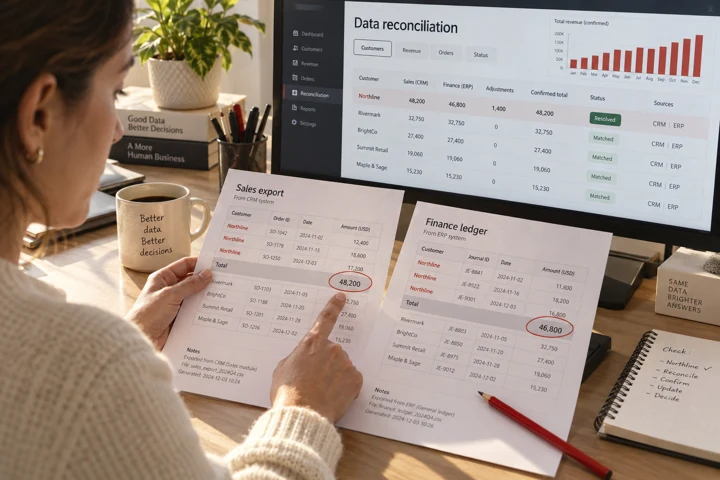
The symptoms are easy to recognize. Meetings start with a discussion about whose numbers are correct. Reports arrive too late. Different departments describe the same situation in different ways. Problems become visible only when they are urgent. At that point, management is not steering the system. It is reacting to fires that should have been detected earlier.
When a decision depends on the person who knows where the spreadsheet is, how the metric is calculated or which version of the report is final, the company does not have a mature decision-making system. It has dependency on individuals.
What it means to have the right data
The right data does not mean all data. This distinction matters. Management does not need endless columns, charts and tables. It needs data that answers the right questions. Which opportunities can realistically close? Which projects are late and why? Which clients consume the most resources? Where do support requests repeat? Which process delays delivery?
A mature reporting system separates signal from noise. It does not show everything simply because everything exists. It shows what supports decisions. That is why a BI platform must be connected to a business question, not only to a technical implementation.
Good data is timely, verifiable, owned, connected to responsibility and presented at the right level. A CEO does not need the same view as an operational manager. Sales does not need the same view as finance. But all of them need to look at the same version of reality.
A mature decision system starts before technology
A mature decision system begins with the decisions the company wants to improve. Then it defines the processes where data is created. Only after that does it make sense to design dashboards, reporting flows or integrations.
If the sales process is unclear, a CRM will not solve the problem. If projects do not have clear owners and statuses, project reports will not be reliable. If people enter data inconsistently, the dashboard will only accelerate confusion. Digital solutions must support the process, not hide the absence of one.
In practice, good decision-making connects three levels: operational work, management control and strategic direction. When those levels are not connected, the company may have many reports but little real clarity.
Why connected systems matter more than another report
Fast-growing companies often respond to every new problem with a new spreadsheet. It helps for a while, but over time it creates layers of improvisation. Each team builds its own view, and management is left to combine data that was never designed to work together.
When CRM, projects, tickets, tasks and reporting are treated separately, leaders see fragments. They may see sales performance but not delivery capacity. They may see the number of projects but not the bottleneck. They may see tickets but not the process that creates them.
This is where the bridge toward an integrated business platform becomes important. The point is not to add another tool. The point is to connect work, responsibility and data so reporting becomes a natural output of how the company operates.
How Positive approaches data and decision-making
Positive approaches this topic from a business perspective first. We start by understanding goals, processes and key decision points. Then we look at where data is created, how reliable it is, who uses it and which decisions it should support.
This reduces the risk of investing in technology that looks modern but does not change management behavior. A good decision system is not a collection of charts. It is an operating logic: what is measured, who owns it, when action is taken and how results are reviewed over time.
If management wants better decisions, the first step is not to ask for another report. The first step is to identify which decisions are currently slow, unclear or too dependent on instinct. That is when business analytics becomes a management tool.
Pitanja koja menadžment najčešće postavlja
Does every company need BI?
Not every company needs a complex BI setup, but every growing company needs a structured way to track key indicators. The form depends on size, processes and organizational maturity.
What should come before business analytics?
First define the decisions management wants to improve. Then map the data, sources, tools and ownership needed to support those decisions.
Why are spreadsheets not enough?
Spreadsheets can help at the beginning, but they become risky when there are multiple versions of truth, manual updates and dependency on individuals.
Does analytics replace management experience?
No. It strengthens management experience with a clearer view of reality. The best decisions combine experience with reliable data.
How do we know reporting works?
It works when leaders see problems earlier, agree on facts faster, know who owns the next step and can track the impact of decisions over time.
Sledeći korak za tim koji želi više kontrole
If your management team needs a clearer view of the business instead of scattered spreadsheets and late reports, book a consultation with Positive.
Related services: business consulting