In this article7 sections
Finance is no longer only a record-keeping function
In many companies, finance is still treated as the department that processes invoices, records transactions, monitors deadlines and prepares reports at the end of the month. That work is important, but it is no longer enough. As a company grows, adds more projects, more teams, more sales channels and more cost centers, finance becomes the place where you can see whether the business system is truly under control. Digital transformation in finance is therefore not just about replacing accounting software. It is about changing how a company collects data, verifies accuracy, monitors costs and supports decisions.
The problem rarely appears because the finance team lacks knowledge. It usually appears because data arrives late, comes from too many systems, has different structures, is copied manually and needs constant checking. Management receives the picture only after some decisions have already been made. In that environment, finance becomes reactive. The team works hard, but the organization still does not have timely insight.
Where finance processes usually break down
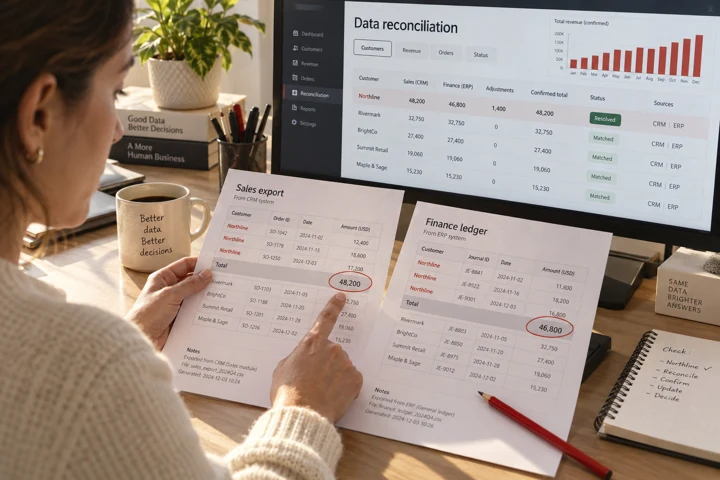
The first issue is scattered data. Sales has its CRM, operations manages projects, documents travel by email, invoices arrive through different channels and part of the information remains in spreadsheets that only one person understands. When finance needs to prepare a report, it first has to collect, align and clean the data. That creates delays and increases the risk of mistakes.
The second issue is the weak connection between finance and operations. If project hours, order statuses, procurement costs, sales opportunities and contractual obligations are not connected, the financial result becomes visible too late. A company may have revenue but still lack a clear understanding of which clients, projects or departments are actually profitable.
The third issue is dependence on individuals. If only one person knows where the latest report is, what each column means and how a certain indicator is calculated, the company does not have a system. It has knowledge locked inside a person. That is risky for any organization that wants to make serious decisions about investment, hiring, pricing or growth.
What changes when finance becomes digitally organized
Digitally organized finance does not mean that software makes business decisions. It means that financial processes rely on accurate, connected and verifiable data. The first effect is a shorter month-end closing process. When data does not need to be collected manually from multiple sources, the finance team can close the period faster, check deviations and prepare reports that management can actually use.
The second effect is stronger cost control. When costs are tracked by projects, departments, clients or activity types, management can see where money is really going. The conversation becomes more precise. Instead of saying that costs increased, the company can identify which costs increased, where, why and how they affect margin.
The third effect is better decision-making. When business analytics connects financial and operational data, a director does not need to request a new ad hoc report for every question. Some answers can be seen through dashboards, while the finance team gains more time to explain causes instead of only preparing tables. BI tools make sense only when they are connected to real processes and clear management questions.
Finance automation must start with process design
A common mistake is to begin with the question: which software should we buy? A better question is: which finance process creates the most delay, error or uncertainty today? It may be invoice processing, project profitability tracking, approval workflows, management reporting or budget control. If the process is not understood first, a new tool simply digitizes the existing disorder.
That is why it is useful to map the financial flow from the business event to the management report. Where is the data entered? Who verifies it? Who approves it? Where is time lost? Where is the same information entered twice? Where are decisions made without enough information? Only then can the company decide whether the priority is finance automation, better BI, CRM integration, project system integration or standardization of procedures.
Which indicators are worth tracking
A company should not track everything. Too many dashboards can create the same confusion as too many spreadsheets. It is better to select a small number of indicators that support real decisions. For some companies that means revenue and margin per project. For others it means costs by department, collection, cash flow, delayed invoicing, capacity utilization or budget variance.
Every indicator needs an owner. If nobody is responsible for the data, the report quickly becomes decoration. Each KPI should have a definition, a data source, a review rhythm and a person responsible for interpretation. Without that, management receives numbers but not a management system.
How Positive approaches finance transformation
Positive does not view finance separately from the rest of the business. When a client has a reporting problem, we first check where the data comes from, which processes create it, who uses it and which decisions it should support. Sometimes the first step is business consulting and process design. Sometimes the company needs a better software layer. Sometimes BI is the priority. Sometimes the issue is that infrastructure, document access or security are not mature enough.
The next step is usually diagnosis, not immediate implementation. The goal is to separate symptoms from causes. If reports are late, the cause may be software, but it may also be weak approval logic, scattered documents, unclear statuses or misalignment between sales and operations.
The next step for management
Another important point is scenario planning. Finance should not only show what happened, but also what may happen if costs increase, collection slows down, a project exceeds budget or revenue structure changes. When the company has connected data, scenario analysis becomes more useful and management can react earlier.
If financial reports arrive late, if the same data is checked multiple times or if management decisions rely heavily on assumptions, the issue is not only administrative. It is a signal that the business system does not provide a clear enough financial picture. The first step is to review processes, data sources and the decisions those data should support.
If you want to identify where finance processes slow down decision-making and how to connect them with the wider business system, book a consultation with the Positive team.
Frequently asked questions
Does finance transformation mean replacing accounting software?
Not necessarily. Software may be part of the solution, but the main goal is to connect processes, data, responsibilities and reporting.
What is the first step?
The first step is to map financial flows and identify where data is delayed, lost or manually checked.
Do BI tools solve financial reporting?
BI helps when data sources are reliable and management questions are clear. If processes are weak, BI only visualizes the disorder.
Who should own this project?
Finance must be involved, but the project owner needs management support and access to operational departments.
When is the right time to transform finance?
When reporting is late, costs are unclear, decisions depend on manual data preparation or the company grows faster than its processes.