In this article10 sections
In “Zoom in – zoom out,” Darko Perović connected a personal experience with a question every leader faces: when should we move closer to the details, and when should we step back to understand the whole? His starting point was a paragliding flight above Vojvodina. His central insight was that neither perspective is sufficient on its own.
Editorial note (October 2026): This is a restored and expanded edition of Darko Perović's Positive article, originally published on 18 December 2024. The birthday gift from his wife, the flight at roughly 1,000 metres, the family waiting on the ground and the central lesson about perspective come from the original. The explanations, workplace scenarios and practical questions below are Positive editorial additions, not new statements attributed to the author.
A flight that changed the viewpoint
The original story began with a birthday present: Darko's wife gave him the opportunity to fly in a paraglider. When the day arrived, the initial rush of excitement gave way to quiet, wind and an unusually broad view of the plain. At around a thousand metres above Vojvodina, roads, settlements and fields formed a connected landscape unlike anything visible from a car.
In a brief moment, he could take in an area that would take much longer to explore on the ground. Yet there was a trade-off. From that height, identifying the take-off point or picking out the family waiting below was almost impossible. The view became wider but less precise.
That contrast carries the essay's central message. Distance helps us understand how things relate to one another. But if we need to know what is happening at one specific point, we must get closer. Neither the view from above nor the view from the ground tells the whole story.
What do “zoom in” and “zoom out” mean?
Zoom in means concentrating on a specific task, conversation, figure, mistake or decision. Close attention lets us check what happened, who is involved and which step is missing. It is essential for delivering good work and resolving immediate obstacles.
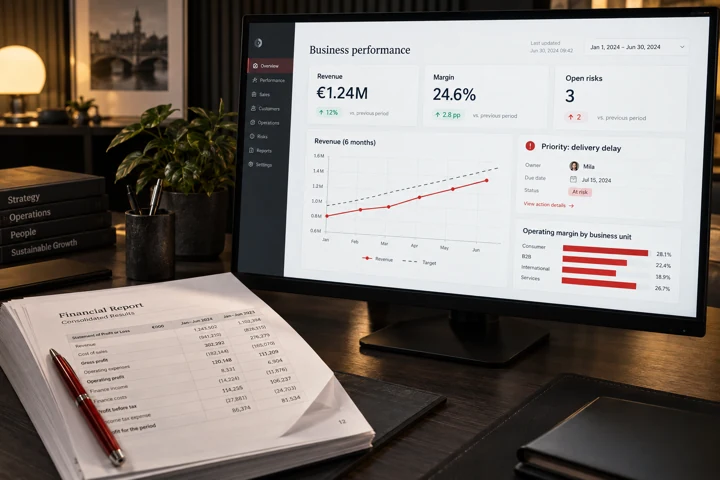
Zoom out means creating enough mental distance to ask broader questions: why does this problem keep recurring, how does it connect to other processes, and what happens if we fix only its most visible symptom? This viewpoint helps with priorities, coordination and long-term direction.
The distinction is not between “operational” and “important” work. A detail may be decisive, while the bigger picture may reveal that we are working on the wrong problem. The skill lies in choosing the right level of attention and knowing when to change it.
Why do managers get trapped in details?
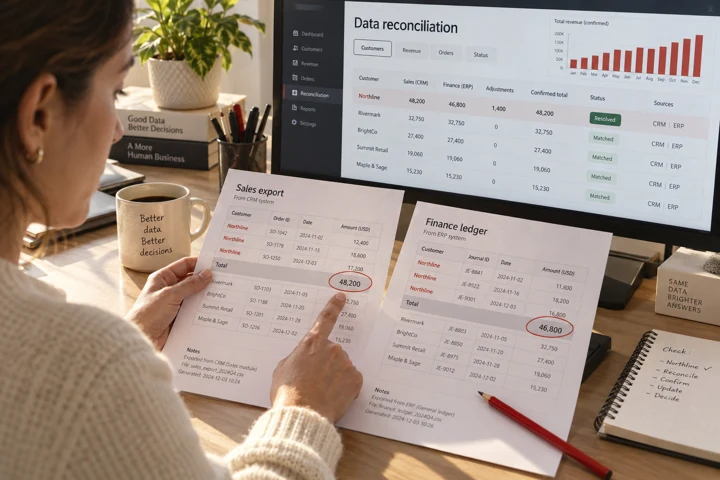
When the day fills with messages, requests, deadlines and urgent decisions, progress can start to feel like the number of small issues resolved. A manager may become the busiest person in the team while having less and less time to check whether everyone is moving in the right direction.
Micromanagement does not always come from distrust. Sometimes it grows out of the habit of intervening immediately whenever something goes wrong. Repeated often enough, that pattern can teach employees to wait for approval on every choice and leave the manager little time for planning or developing people.
Stepping back does not mean abandoning employees or ignoring problems. It means asking whether the team needs a clearer rule, a shared goal, delegated authority or the removal of an obstacle that keeps triggering the same intervention.
When do we need to return to the details?
The opposite risk matters too. A leader can spend so much time on vision, plans and presentations that the reality of day-to-day work becomes distant. The strategy sounds convincing, but people do not know who decides, which data to trust or what they should complete today.
This is where zooming in is essential. Instead of saying a project is “behind schedule,” follow one task through the process: where did the request enter, who took ownership, where did it wait and how many times was it sent back? The answer may reveal an unclear handover rather than a lack of effort.
Details become particularly important when a decision affects safety, service quality or customer trust. A broad strategic view does not remove responsibility for what actually happens.
Moving between perspectives when making decisions
Useful decisions often involve several short moves between levels. First, describe the problem as it appears. Next, step back to see whether it is a symptom of something larger. Finally, return to a small, testable action that can confirm or challenge the assumption.
Imagine customers repeatedly asking a support team the same question. Close up, we see individual tickets and response times. From a distance, we might notice that an instruction is unclear or that a step in the product is confusing. We can then zoom back in and test a clearer explanation with a few real cases rather than claiming it will automatically solve everything.
This is an illustrative editorial scenario, not a claim about a particular Positive customer or a measured client result.
Five questions that help change perspective
When a team is stuck in debate or the same issue keeps returning, a brief change of focus can help:
- What can we verify? Separate observed facts from assumptions and impressions.
- What is missing from this angle? Consider the perspective of an employee, customer or another team.
- Are we treating a cause or a symptom? Check whether the issue is isolated or repeats across the workflow.
- Which detail is decisive? Identify the information or step needed before making a responsible decision.
- How will we check progress? Agree on a simple test, an owner and a moment to review the wider picture again.
These questions are not a universal formula. Some situations call for immediate action; others need careful analysis. Their value is that they prevent us from treating our first viewpoint as the only possible one.
The team's perspective: different people see different parts
A manager may know the goals, budget and deadlines, while an employee sees the operational details that could derail the plan. A customer notices the experience of receiving a service, not the company's internal structure. Each person holds part of the picture, but no role automatically sees everything.
Changing perspective is therefore more than a private thinking skill. It is also a way of listening. Before reaching a conclusion, ask the people closest to the work what is happening and which obstacle they would remove first. This does not mean every decision must be made by committee; it means a decision should not rest on a single angle.
For a related reflection on habits, communication and leadership, see Personal Development: The Key to Success and Change.
Finding balance without endless analysis
Another trap is using the “bigger picture” as an excuse to postpone action. There is always another scenario, another presentation or another question to consider. Yet acting too quickly can lock an ineffective process in place. Balance needs a time frame: understand enough to choose the next step, then check what that step teaches us.
For example, a team might identify its main objective and risk at the start of the week, monitor concrete obstacles during the work and revisit the broader goal at the end. A complicated reporting system is not necessary. The important thing is making changes of focus deliberate rather than accidental.
This balance between direction and execution also connects with change management. The connection is conceptual; it is not a claim that one method fits every organisation.
The lesson also applies outside the office
The original essay reminds readers that changing perspective is not a skill reserved for executives. Parents, partners and friends can become so focused on an immediate obligation that they miss what another person needs. At other times, large plans take up so much attention that a small but meaningful moment goes unnoticed.
Not every disagreement can be solved simply by “stepping back.” But it is worth asking whether a missing detail or missing context is shaping our reaction. Sometimes we need to listen more closely. Sometimes we need to examine how a situation has developed over time.
Conclusion: the view from above and the next step on the ground
Paragliding offered a vivid image of a leadership skill. From high above, connections become visible that are hidden at ground level, while the people and details closest to us become harder to distinguish. Neither perspective needs to win. We need to know when each is useful.
The most productive question may therefore be not “Should I focus on details or the big picture?” but “What am I unable to see from where I am standing now?” The answer can point us towards a closer conversation, a practical check or a moment of distance from the daily rush.
Source note: The personal experience and central metaphor are based on the original Positive article from December 2024. The practical explanations are editorial additions. The reading references are offered for context, not as a claim that the original author relied on them.
Related service: Positive culture and values.
Frequently asked questions
What is zooming in as a leader?
Zooming in means deliberately focusing on specific facts, people and steps needed to understand and resolve an issue.
What is zooming out in management?
Zooming out means stepping back from one task to see goals, connected processes, recurring causes and the effects of a decision.
Is the big picture more important than details?
Neither view is sufficient alone. The big picture helps set direction, while details reveal what is actually happening and how to act.
How can leaders avoid micromanagement?
Set clear goals and ownership, review outcomes rather than every step and remove recurring obstacles that keep requiring intervention.
How can a stuck team change perspective?
Separate facts from assumptions, listen to different roles, check whether the issue is a symptom and agree on one testable next step.
Who wrote the original Zoom in – zoom out article?
Darko Perović wrote the original Positive article published on 18 December 2024. This edition includes clearly labelled editorial additions from October 2026.