In this article7 sections
Data is valuable only when it changes decisions
Companies have more data than ever, but that does not automatically mean they have more control. Data often lives across emails, spreadsheets, CRM systems, ERP systems, tickets, documents, chat messages and individual memory. On paper, everything exists. In real work, when management needs an answer, the search begins: who has the latest version, which report is accurate, where is the meeting note, what was agreed with the client and why do two systems show different numbers?
This is why business data is becoming one of the most important topics in digital transformation. Not because data is fashionable, but because it determines the speed, accuracy and quality of decisions. A company that does not know where its data lives, who owns it and how it is used cannot seriously talk about automation, AI, analytics or scaling. It may have tools, but it does not have a reliable system.
The real value of data appears when it stops being passive documentation and becomes an active part of management. That means leadership does not wait until the end of the month to understand what happened. It can see what is changing while work is happening, where risk is appearing and where action is needed.
Why companies often have data but not one version of truth
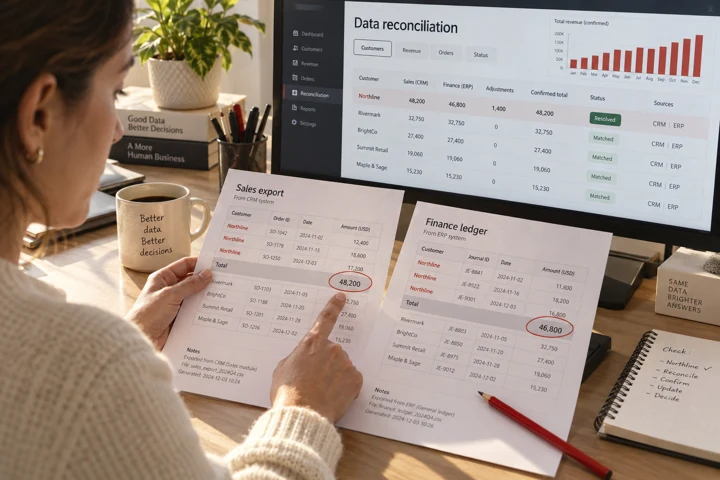
The common problem is not a lack of data. It is too many disconnected versions of the truth. Sales has its own spreadsheet. Finance has its own report. Operations has its own notes. Management receives summaries that are already delayed, filtered or dependent on the person preparing them. When every function has its own view of reality, meetings stop being about decisions and become debates about which number is correct.
That creates a hidden cost. Meetings last longer, decisions are delayed, people manually check information, and accountability becomes unclear because there is no shared source of truth. In that environment, even good software can become another layer of complexity. If there is no agreement on what the official data point is, who enters it, who validates it and where it is used, the system will produce confusion faster than value.
That is why data must be viewed together with processes. Digital transformation does not begin with a screen. It begins with a question: which decisions do we want to improve, and what data do we need to make them better? Only then do platforms, dashboards, integrations and AI solutions make sense.
Data as the foundation for AI, automation and analytics
AI projects expose the real state of company data very quickly. When people say they want an AI assistant, predictive analytics or process automation, the next question is simple: where does the system get its knowledge, and how reliable is that knowledge? If documents are outdated, procedures are unclear, statuses are inconsistent and ownership is undefined, AI will not solve the problem. It will only reveal it faster.
The same applies to business analytics. A dashboard is useful only if the data behind it is accurate, understandable and up to date. Otherwise, the company gets a nicer view of uncertainty. Visualization does not fix wrong input. Automation does not fix a broken process. AI does not fix missing ownership of knowledge. Data must therefore be treated as business infrastructure, not as a side technical topic.
When data is organized, the effect spreads across the entire company. Sales understands opportunity status. Leadership sees the real pipeline. Finance closes the month faster. Operations knows who is responsible for what. Customer support sees request history. AI assistants can provide better answers. Data becomes a shared operating language.
What mature data management actually means
Mature data management does not mean every company needs a heavy governance program immediately. For most mid-sized companies, the first step is practical: define which information is critical, where the official version is stored, who is responsible for accuracy and how the data is used in decisions. Without that minimum, every new tool works on a weak foundation.
A good starting point is a map of key data. It does not need to be academic. It should show what the company needs to know about customers, projects, tasks, contracts, documents, tickets, finances and people. Then it should define where that information lives and who maintains it. Only after that should the company plan system integration, automated reporting or AI usage.
The risk is creating too many rules and too little value. Governance is useful only when it helps people work more clearly, quickly and safely. If it becomes bureaucracy, people will bypass it. If it reduces errors and improves decisions, it becomes part of the way the company works.
How Positive connects data with the wider business ecosystem
Positive does not treat data as an isolated IT topic. Data connects strategy, processes, software, infrastructure, security and AI. If one part of the system is weak, other parts feel the consequences. Serious transformation therefore does not ask only which tool to buy. It asks how to connect processes, data and people into one operating system.
In practice, a discussion about data often becomes a discussion about the entire business system. Does the company have clear processes? Is there business software that keeps data in one place? Are documents available and protected? Does management have reports that genuinely support decisions? Can AI use the data safely and under what rules? These questions define the company’s real maturity.
A company that treats data as an asset is not doing it for a prettier report. It is doing it to reduce improvisation, make faster decisions, gain better control and become less dependent on individuals. That is when data stops being technical documentation and becomes a foundation for growth.
What the first month of data work can look like
The first month should not be spent on large presentations or an ambitious map of the entire company. A better approach is to choose one area that often creates problems: sales pipeline, service requests, contracts, financial reports or project documentation. Then collect all sources used for that area and compare them with the questions management asks most often.
This review quickly reveals where confusion begins. Sometimes the same data is entered in three places. Sometimes a field exists but nobody updates it regularly. Sometimes a report looks accurate, but arrives too late to support a decision. These operational details determine whether data has real business value.
Once one area is organized, the company gets a pattern it can repeat. That is healthier than trying to create a perfect data system for the entire company at once. Digital maturity comes from repeatable work, not from a one-time initiative.
The next practical step
If management does not trust the data it receives, the problem is not only the report. The problem is the system that produces the report. The first serious step is not buying another dashboard. It is understanding which data is critical, where errors appear and which decisions are slower or weaker because the company lacks a reliable view.
If you want to assess whether your data is ready for digital transformation, automation or AI, book a consultation with Positive. The goal is not another dashboard. The goal is to know which data must be organized first so the whole business system can work smarter.
Related services: business consulting