In this article12 sections
Business data protection is not a single product or a one-time installation. It is a combination of policies, technical safeguards and everyday practices that reduce the likelihood of unauthorised access, lost information and prolonged disruption. When information connects employees, customers and business systems, security becomes a matter of continuity and trust, not only an IT department responsibility.
Editorial note (October 2026): This is a restored and expanded edition of Positive's “Zaštita podataka: Ključne strategije sigurnosti” (“Data Protection: Key Security Strategies”), first published on 17 March 2025 and credited to Positive in the Cybersecurity category. Its five original areas are preserved: security protocols, employee training, advanced protective tools, backups and recovery planning, and compliance with relevant standards and regulations. The additional risk-assessment, access-control and incident-response guidance is editorial material. Legal obligations depend on jurisdiction, data categories and activities; this article is not legal advice.
Why data protection is a business priority
A company can lose access to important information through ransomware, hardware failure, misconfiguration, accidental deletion or a compromised account. The consequences may extend well beyond one computer, affecting invoicing, customer communication, service delivery and the ability to meet contracted deadlines.
Security therefore needs to address confidentiality, integrity and availability. Confidentiality means information is available only to authorised parties. Integrity means changes can be detected and assessed. Availability means that valuable information and systems remain accessible when the business needs them. A sound strategy protects all three rather than assuming one control will solve every risk.
The first step is to understand what data the company holds, where it resides, who owns it and what would happen if it were lost or exposed. Priorities cannot be realistic without that context.
1. Strong protocols: encryption, MFA and reviews
The first theme in the original article covered strong security protocols. Encryption protects information in transit and at rest when cryptographic keys and their access are appropriately managed. An HTTPS connection does not replace account security, and an encrypted drive cannot protect information against every action taken by a compromised administrator.
Multifactor authentication (MFA) reduces the risk associated with exposed or stolen passwords. It is particularly valuable for administrator accounts, remote access, email and cloud services. Where feasible, phishing-resistant authentication methods deserve priority, with careful attention to recovery paths that might otherwise bypass strong protection.
Regular security reviews complete this set of controls. Examine active accounts, privilege changes, unsupported software, exposed services and whether teams follow their documented rules. An audit should result in accountable corrective actions and deadlines, not merely a report left in a shared folder.
2. Continuous security education for employees
The second historical theme focused on people. Fraudulent emails, requests to change bank details, suspicious links and impersonation of trusted suppliers often target everyday business communication. Training needs to show employees how to recognise a suspicious request and where to report it without fear of blame.
Useful topics include phishing recognition, password practices, company devices, safe network use and what to do when something unusual happens. Instead of a single annual presentation, organisations can deliver short scenarios tailored to sales, finance, human resources and IT teams.
A healthy security culture does not emerge by declaring staff the weakest link. It develops when people have understandable procedures, a trusted reporting channel and support when they ask for help. Mistakes should inform improvements to systems and processes, not only identify someone to criticise.
3. Protective tools: firewalls, endpoint security and IDS/IPS
The third original topic was technology. Firewalls can limit unwanted network traffic, endpoint protection can help detect malicious software, and intrusion detection or prevention systems can monitor or block particular intrusion patterns. Each tool addresses part of the problem and depends on appropriate configuration and supervision.
No platform should be presented as a guarantee that an attack cannot happen. An alert without an accountable person and a response process may go unnoticed. Excessive noise from security systems can also bury meaningful warnings, so priorities and rules require ongoing adjustment.
When selecting products, assess what logs they collect, where those records are stored, who can access them and what follows when a possible threat is found. Tools need to support a coordinated process of verification, containment and recovery.
4. Backups and disaster recovery plans
The fourth theme was backup and recovery. Backups matter because even well-protected environments can suffer failures, human error or an attack. Copies need to be taken regularly, separated appropriately from primary systems and protected against an attacker or mistaken automation changing or deleting them.
Keeping multiple versions helps when damage is detected late. Separate, immutable or offline copies can be appropriate according to the company's resources and risk assessment. However, possessing backups is not proof that a useful recovery is possible.
Recovery tests are essential. Define an acceptable amount of data loss, often expressed as a recovery point objective (RPO), and an acceptable service outage, or recovery time objective (RTO). Then rehearse restoring the information, identify who makes decisions and establish the order in which business-critical applications must return.
5. Standards, regulations and accountability
The fifth historical theme mentioned GDPR, ISO 27001 and HIPAA. These are not interchangeable. The GDPR is an EU regulation governing personal data processing when its scope conditions are met. ISO/IEC 27001 is an international information security management systems standard. HIPAA is a United States legal framework relevant to certain healthcare organisations and their business associates.
Operating from Serbia does not make all these frameworks apply automatically or in the same way. Serbia has its own Law on Personal Data Protection. The GDPR may also apply in particular cross-border circumstances, such as offering goods or services to individuals in the EU or monitoring their behaviour, subject to the applicable legal tests.
Compliance is more than displaying a privacy notice. Organisations should understand the lawful basis for processing, responsibilities, retention periods, processor agreements and incident procedures. Qualified legal advice is necessary when identifying specific obligations and reporting deadlines.
Start with a data inventory and classification
Controls can only be proportionate when the business understands its information assets. Which systems store customer details, financial records, employment information or trade secrets? Are copies spread across laptops, cloud applications, email archives and portable media? Without a basic inventory, a company cannot reliably assess what a disruption could affect.
It is useful to classify data by sensitivity and business importance. Public marketing material requires different safeguards from customer databases or administrator credentials. Classification does not have to become bureaucratic; a few understandable levels can work if people apply them consistently.
Assign an owner to each important information system. The owner need not be the engineer who maintains it. The important point is that someone understands the information's business purpose and can approve appropriate access.
Least privilege and access management
Many incidents become more damaging because an account has permissions far beyond what is needed. The principle of least privilege means giving users, applications and services only the access required for a particular job. Administrative rights should be separated from routine activity and managed more carefully.
Changes in employment are especially important. New staff need appropriate access, internal transfers may require permissions to change, and departures must trigger timely removal. Forgotten service accounts and obsolete API keys can become persistent weaknesses.
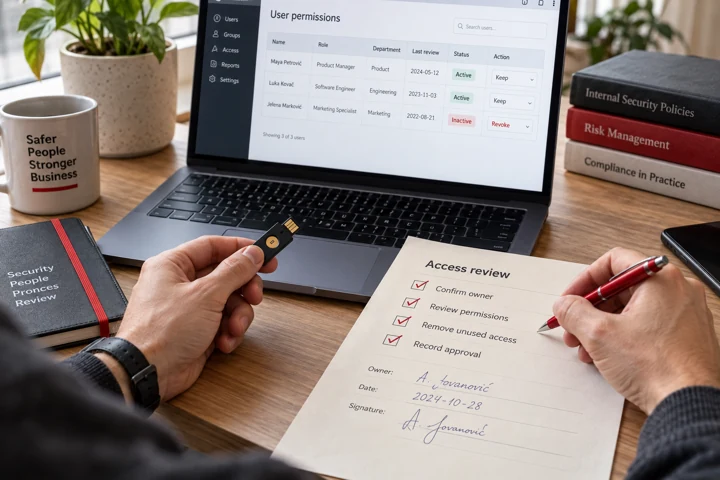
Periodic access reviews make the policy meaningful. Check who still has access to financial data, customer documents and system configuration. When permissions are tied to clear business needs, they are easier to maintain without obstructing legitimate work.
Updates, vulnerabilities and suppliers
Outdated applications and incorrect configurations increase the attack surface. Maintaining an inventory of software, devices and online services, with a responsible owner for each, helps ensure security updates are not forgotten on an obscure system.
Priorities should not depend only on a vulnerability score. Consider whether a flaw is actively exploited, whether the affected service is internet-facing, what information it handles and how costly downtime would be. The highest-risk systems may need expedited fixes or temporary controls while a permanent patch is prepared.
Suppliers and contractors can introduce risk through their access. Before connecting their services, review contractual expectations, permissions, update practices and incident notification procedures. Protecting a business ecosystem means understanding relationships outside the company as well.
Monitoring and responding to incidents
No preventive measure is perfect. Organisations need to know how a suspected incident will be recognised, who will confirm it, how harm will be limited and who should communicate with management, customers or authorities when necessary. Plans should be usable under pressure rather than hidden in lengthy documents.
A typical workflow includes reporting a suspicious event, preserving relevant logs, analysing the problem, restricting access to affected systems, removing the cause, restoring services and reviewing lessons learned. The sequence depends on the circumstances; carelessly removing evidence can make investigation harder.
Useful plans include contact details, backup decision-makers, escalation thresholds and criteria for external notification. Personal data breaches may trigger legally defined reporting obligations, making advance coordination between legal and security functions important.
Choosing the first practical priorities
A company does not have to introduce every safeguard on the same day. Start by reviewing administrator accounts and MFA, the reliability of backups, critical internet-facing services, update practices and the channel employees use to report suspicious messages. These are concrete areas where gaps can often be identified quickly.
Record the finding, potential impact and person responsible for fixing it. Keep evidence such as a successful restore test, training record, access review or proof of a corrected configuration. A list of purchased security products is not evidence that the protective measures are operating effectively.
For a longer-term programme, the NIST Cybersecurity Framework 2.0 can help organise conversations around Govern, Identify, Protect, Detect, Respond and Recover. It is a framework for managing risk and clarifying responsibilities, not an automatic certification or substitute for legal requirements.
Conclusion: effective protection uses layers
The original Positive article identified five central strategies: strong protocols, employee education, protective tools, backups with recovery plans, and attention to relevant rules. Together they remain a practical starting point for discussing data protection and business continuity.
Results do not appear merely because antivirus software is installed or a policy is written. Responsibilities must be clear, controls need testing, people require support, information should be classified and recovery plans must be rehearsed. This does not promise that an incident will never occur. It gives the organisation a better chance of reducing risk, detecting problems and returning to dependable operations.
Related service: CoreTech IT infrastructure.
Frequently asked questions
What are the main strategies for protecting business data?
Strong protocols and MFA, employee education, monitored security tools, reliable backups with tested recovery, and appropriate regulatory compliance.
Are encryption and MFA sufficient?
No. They protect important parts of a system, but access controls, monitoring, updates, incident planning and backups are also necessary.
How often should backup restores be tested?
Frequency depends on business risk and requirements. Restores should be tested regularly to confirm that data and services can return within agreed objectives.
Does GDPR apply to every company in Serbia?
Not automatically. Applicability depends on the GDPR's scope rules, including certain activities involving individuals in the EU, alongside Serbian law.
What is the principle of least privilege?
A user or application receives only the access necessary for its work, with unnecessary permissions reviewed and removed.
What should employees do when they suspect a cyber incident?
Use the defined reporting channel, notify the responsible team, preserve relevant evidence and follow the incident response plan.