In this article9 sections
The invisible layer that often decides business performance
In many companies, IT infrastructure is treated as a technical background layer. When everything works, it rarely gets attention. When something breaks, it quickly becomes clear that infrastructure is not a minor IT detail. It determines whether employees can access documents, whether applications respond on time, whether customers receive answers and whether management can rely on data.
The real question is not whether the infrastructure is good enough for IT. The better question is whether it is good enough for the business the company wants to run. If the company plans growth, digitalization, automation or AI, infrastructure becomes a business foundation. It affects speed, security, productivity and reliability.
Positive approaches this topic as part of digital transformation. Infrastructure is not just servers, networks, computers or cloud accounts. It is the base that enables people to work with fewer interruptions, systems to communicate, data to remain available and the organization to scale without unnecessary operational friction.
What infrastructure means from a business point of view
Technically, infrastructure includes devices, networks, servers, cloud services, backup, cybersecurity tools, user access, licenses, monitoring and support. From a business perspective, it means something more practical: people can work without constant interruptions, data is available when needed, and the company can continue operating even when problems appear.
Management does not need to understand every technical component. It does need to understand the consequences. When the sales team cannot access the CRM, it is not just a software issue. When finance waits for reports because systems are slow, it is not just an application problem. When documents live in uncontrolled locations, the deeper issue is often a weak operating foundation.
A mature company does not only ask what equipment it owns. It asks how technology, software, networks and support influence the working day and the ability to deliver results.
When a technical issue becomes a business risk
The most dangerous infrastructure problems are not always dramatic outages. Sometimes the system works, but slowly. Applications open late, files are difficult to find, support reacts only after escalation and employees build workarounds. That may look acceptable until the company measures how much time and attention it loses every week.
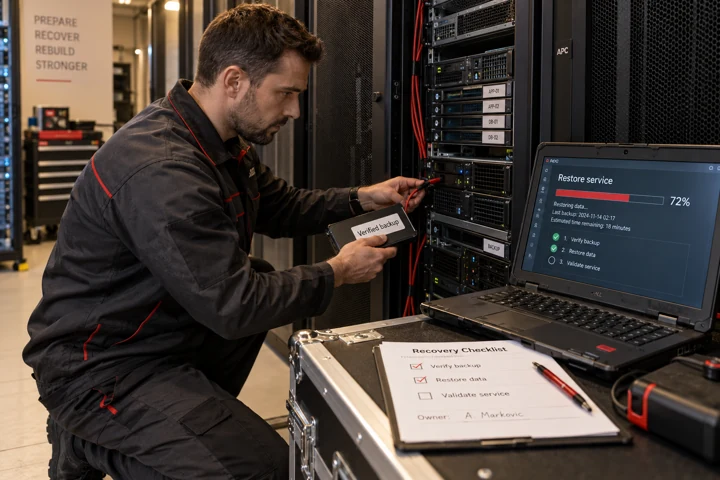
A technical issue becomes a business risk when it affects deadlines, customers, data, reputation or decision making. Poor backup is not only a file issue. It is a continuity risk. Weak access control is not only a password issue. It is a risk to business information. Lack of monitoring is not only a missing tool. It means problems are discovered too late.
That is why cybersecurity, backup, support and infrastructure need to be viewed as connected layers of business continuity.
Why digital transformation depends on the foundation
Digital transformation often starts with ambition: new software, better reporting, AI assistants, automation, integrations and cloud platforms. But if the foundation is unstable, these initiatives quickly meet reality. Data is not ready, systems are not connected, access rules are unclear and performance is not reliable enough.
This does not mean a company needs perfect infrastructure before every digital project. That would become an excuse for delay. It means the company must know where the weaknesses are and which of them need to be resolved before or during implementation. Otherwise digital transformation becomes a series of disconnected initiatives that look modern but do not change how work gets done.
Good business consulting and strong IT planning belong together. The business goal comes first. Then the organization checks whether the technology foundation can support it.
How to treat infrastructure as a management decision
The first step is not buying new equipment. The first step is mapping business risk. Which processes must not stop? Which data is critical? Which systems have the strongest influence on productivity? Who owns continuity? Without these questions, infrastructure remains a technical shopping list.
The second step is prioritization. Not everything needs to be fixed at once. But the company needs to know what is foundational, what is risky, what can be improved quickly and what requires a wider project. Positive connects digital solutions, infrastructure and business priorities into a sequence that reduces risk and creates visible progress.
The third step is moving from reactive support to a more proactive model. A company that waits for problems to become visible usually pays more, even when the cost is not obvious on one invoice. Proactive work does not remove every problem. It helps identify them earlier and reduce their business impact.
The next step for leadership
Management does not need to manage cables, servers and licenses. It does need to manage risk, continuity and priorities. That is why infrastructure should be reviewed through business questions at least once a year: what slows people down, what puts data at risk, what cannot support growth and where would downtime hurt the most?
If the company plans AI, automation, analytics or new business software, infrastructure assessment is not a side activity. It is a way to avoid building a modern layer on a weak foundation. Technology can accelerate a company only when the system beneath it can support that speed.
A practical management assessment
Leadership does not need to start with a long technical audit. A useful first step is asking a few business questions: which systems are critical, how long can the company operate if one stops, where does key data live, who has access to it and who knows what to do during an interruption?
The answers usually reveal the maturity of the system quickly. If they are unclear, the issue is not only technical. It means the business does not understand its own dependencies. A good assessment should therefore produce a priority list: what needs immediate attention, what can be improved over the next few months, what is strategic and what is unnecessary. That is how infrastructure becomes part of management, not just maintenance.
A practical management assessment
Leadership does not need to start with a long technical audit. A useful first step is asking a few business questions: which systems are critical, how long can the company operate if one stops, where does key data live, who has access to it and who knows what to do during an interruption?
The answers usually reveal the maturity of the system quickly. If they are unclear, the issue is not only technical. It means the business does not understand its own dependencies. A good assessment should therefore produce a priority list: what needs immediate attention, what can be improved over the next few months, what is strategic and what is unnecessary. That is how infrastructure becomes part of management, not just maintenance.
CTA
If you want to assess whether your IT foundation can support growth and digital transformation, book a consultation with the Positive team.
Frequently asked questions
Should small companies think about IT infrastructure?
Yes. They do not need a complex setup, but they need reliable devices, access, backup, support and security appropriate for their work.
When does infrastructure become a business problem?
When it slows employees down, puts data at risk, causes frequent interruptions or cannot support growth and digital projects.
Is infrastructure important for AI projects?
Yes. AI needs access to knowledge, data, systems and rules. Without a stable foundation, AI often remains a demo.
What is the first step in assessing infrastructure?
The first step is mapping critical processes, systems, data, risks and recurring problems.
Does everything need to be fixed at once?
No. The key is to define priorities and sequence improvements from stability and security toward advanced digital solutions.