In this article7 sections
Backup becomes a business topic when work stops
Backup is often seen as a technical activity managed somewhere inside IT. While systems work, leadership rarely asks deeper questions. The topic becomes visible when data disappears, a server cannot be restored, systems are locked after an attack or employees cannot continue working. At that point, data backup is no longer a technical detail. It becomes a business continuity issue.
Executives do not need to know every tool behind the process. They need to know whether the company can continue operating after a failure, mistake or incident. If sales cannot access CRM, finance cannot access documents, operations cannot see orders and management cannot see reports, the problem is not only technical. It affects revenue, delivery and client trust.
This is especially important in growing companies, where systems, users and documents multiply over time. What once could be solved manually becomes too complex for improvisation. Backup must follow the real way work happens, not only the technical structure.
Backup management is therefore not only a tool decision. It is a priority decision. The company must know which data carries the highest business risk, which teams depend on it and what happens if it is unavailable.
For marketing and sales communication, this topic should be explained without technical jargon. Clients often understand the importance of backup only when it is connected with downtime, responsibility and trust, not with storage capacity or tool names.
The real question is what can actually be restored
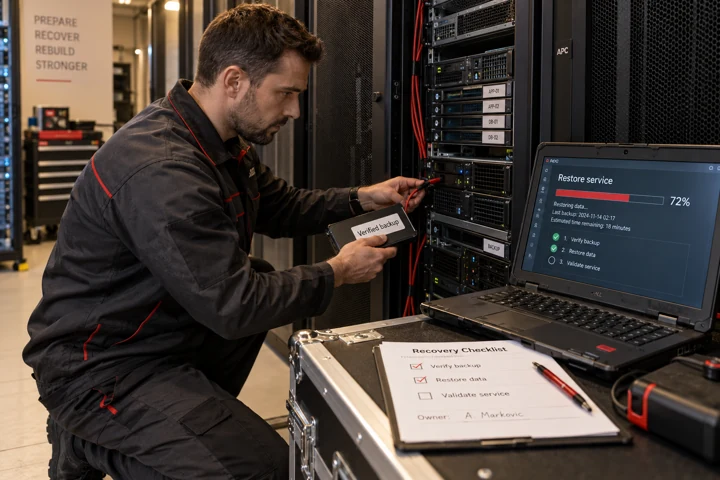
Many companies say they have backup, but that answer is too broad. It matters what is copied, how often, where it is stored, who has access, how long versions are kept and whether restore has been tested. Backup that has never been restored in controlled conditions is not proof of resilience. It is an assumption.
The discussion should be translated into business questions. How much data can we afford to lose? How long can we be down? Which systems come back first? Who makes decisions if recovery takes longer than expected? Without those answers, the company improvises during the incident instead of managing it.
In larger organizations, dependencies between systems create additional risk. One data set may support sales, finance, reporting and customer support. If only part of the system is restored, the process can still remain blocked.
A real restore test is not only whether a file appears. It is whether employees can continue work, applications function, data is consistent and leadership understands how long recovery took.
This way of thinking prevents another common mistake: buying a solution without a clear goal. If the company does not know what it protects and why, even a strong tool will not deliver its full value. When the goal is clear, technology supports measurable business outcomes.
Backup is not the same as archive
Archive and backup are often confused. Archive keeps data for records, legal obligations and history. Backup exists so the business can continue after a problem. A company may have old files, but if it cannot restore the working system quickly, it does not have business continuity.
That is why backup and recovery must be seen through restore capability, not only through file storage. The goal is not to prove that copies exist somewhere. The goal is to prove that systems and data can be returned to a usable state within an acceptable time and in the right order.
This difference matters for financial, contractual and regulatory documents. Archive may prove that a document existed, but it may not help restore the working process quickly. Archive and backup should be connected, but not confused.
Once that distinction is clear, retention rules, responsibilities and recovery expectations become easier to define. One policy can serve history and compliance, while another serves fast business recovery.
This is especially important for companies that already use multiple systems. The more complex the ecosystem becomes, the more important it is to know where data lives, how it moves and which part of the business depends on it.
Security and backup must work together
Backup is a key layer of resilience when an incident happens. Cybersecurity reduces the likelihood of attacks, compromised accounts, unauthorized access and malicious activity. Backup reduces the consequences when something still goes wrong. If either layer is missing, the company remains exposed.
There is a specific risk when backup copies are protected by the same access logic as production systems. If an attacker gains enough privileges, copies may also be deleted or encrypted. Backup therefore needs its own protection logic, access control, versioning, separated storage and clear recovery procedures.
A strong backup setup must be designed as part of the security architecture. This means separated access, protected copies, multiple locations and a procedure that still works if part of the environment is compromised.
If backup shares the same weaknesses as production, recovery may be at risk exactly when it is needed most. The resilience of backup is as important as the fact that copies exist.
When backup is connected with cybersecurity, the company gets a more realistic view of resilience. Prevention matters, but no system should be designed as if incidents will never happen. A mature company plans both protection and recovery.
- Backup must be protected from the same risks it is meant to solve.
- Copies should be tested, not only created.
- Recovery needs sequence, ownership and realistic expectations.
Leadership should ask for evidence, not only confirmation
The sentence we have backup is not enough. Leadership should ask for evidence that the system works. This is not distrust toward IT. It is responsible risk management. A good IT team works better when business priorities, recovery expectations and management support are clear.
The best time to test backup is before an incident. If testing begins only after data is lost, the company is no longer testing. It is in crisis. Backup should be part of a regular review rhythm, especially in companies that grow, introduce new systems or depend heavily on digital work.
These questions should not be seen as micromanagement. They are questions of risk ownership. When leadership knows what it expects, IT can propose better solutions, justify budgets and define realistic recovery times.
Without that conversation, a gap appears. IT may believe it is doing enough, while management expects faster recovery than the system can actually support.
The role of management is not to replace IT, but to define expectations. This means acceptable risk, system priority and investment level based on the real consequences of disruption. Without this, backup remains an operational habit, not a business decision.
How Positive frames the topic
Positive sees backup as part of broader IT infrastructure and business continuity. The goal is not to add another tool that formally creates copies. The goal is to understand what is critical, how it is protected, how it is restored and what happens during disruption. This connects technology, procedures, ownership and business priorities.
A backup conversation should not start with storage capacity. It should start with the business question: what can the company not afford to lose and how quickly must work continue. Only after that should the architecture, retention rules, protection model and testing rhythm be defined.
Positive connects backup with infrastructure, security and business processes. Only when those layers are connected can the solution be reliable without becoming unnecessarily complex.
This approach also helps with priorities. Not everything must be solved at once, but the company must know what comes first, what is critical and what creates the highest risk if left untested.
The next practical step is simple: map critical data, review the existing backup setup and verify whether recovery matches business needs. That is more useful than waiting for an incident to reveal weaknesses.
What is the next practical step?
If you are not sure whether your backup can truly support business recovery, start with an assessment of critical systems, recovery expectations and tested restore capability.