In this article8 sections
Untested backup is an assumption, not resilience
The biggest misconception about backup is that successful copy jobs are enough. A system may show green status while real recovery is slow, incomplete or unusable. That is why backup testing is not an administrative detail. It is proof that the company can continue working when something goes wrong.
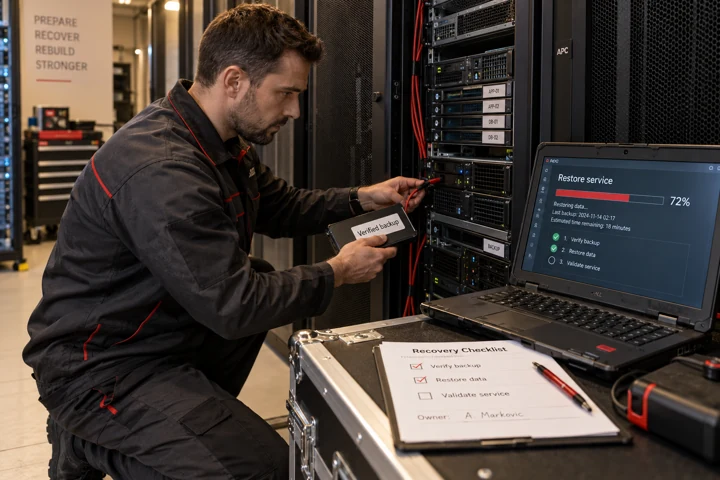
Many problems appear only during restore: missing access rights, outdated copies, databases that do not start, applications without configuration, inconsistent files or unclear sequence of steps. It is better to discover those problems during a planned test than during an incident.
Testing is useful because it removes assumptions from the system. Until recovery is tried, the company does not know whether the steps are clear, people are ready and restore time is acceptable.
A good test does not search for someone to blame. It searches for facts. If a problem appears, that information helps improve the system before a real crisis.
For marketing and sales communication, this topic should be explained without technical jargon. Clients often understand the importance of backup only when it is connected with downtime, responsibility and trust, not with storage capacity or tool names.
First define what is being tested
Recovery testing should not be random. The company first needs to define what is critical: systems, databases, documents, applications, accounts and configurations that must be available for work to continue. Without that agreement, a test may restore data but still fail to prove that the business process can run.
That is why data backup should be tested through scenarios. What if a user deletes important files? What if a server fails? What if ransomware encrypts data? What if a cloud account is compromised? What if an entire application must be restored? Different scenarios require different checks.
The scenario should be realistic enough to show the link between data and work. If only one file is restored while the real risk is an entire application, the test can create a false sense of safety.
Testing can be done in levels: simple file restore, critical folders, databases, applications and finally the complete continuation of work.
This way of thinking prevents another common mistake: buying a solution without a clear goal. If the company does not know what it protects and why, even a strong tool will not deliver its full value. When the goal is clear, technology supports measurable business outcomes.
A good test measures time, quality and ownership
A test is not only about whether something was restored. It should measure how long it took, whether data is complete, whether applications work, whether users can continue and whether responsible people knew what to do. If the test requires improvisation, that is useful information, but also a signal that the procedure needs improvement.
Recovery sequence must also be defined. Not everything is restored at the same time and not everything has the same importance. Finance, sales, operations, documents and communication may have different priorities. Without a sequence, teams compete for attention and recovery slows down.
Recovery time must be measured because intuition is often wrong. Something that sounds quick in conversation may take much longer once access rights, configurations, dependencies and data validation are included.
Recovery quality matters as much as speed. Fast but incomplete or inconsistent data can create a new problem instead of solving the existing one.
This is especially important for companies that already use multiple systems. The more complex the ecosystem becomes, the more important it is to know where data lives, how it moves and which part of the business depends on it.
- Measure how long critical system recovery takes.
- Check whether restored data is complete and usable.
- Record who performed which step and where delays appeared.
Testing should be documented, not remembered
If test results exist only in one person’s memory, the company has not built a system. It should record what was tested, when, who participated, how long it took, what worked, what failed and what needs to be improved. Documentation is not bureaucracy. It is the basis for better recovery.
Documented testing also helps leadership. Instead of a broad statement that backup works, management sees which system was restored, in what time and with which limitations. That supports better decisions about investment, priorities and acceptable risk.
Documentation protects the company from dependence on one person. If only one employee knows what happened, the organization still has operational risk.
The record does not need to be complex. It should include scenario, participants, recovery time, findings, issues and agreed corrective actions.
When backup is connected with cybersecurity, the company gets a more realistic view of resilience. Prevention matters, but no system should be designed as if incidents will never happen. A mature company plans both protection and recovery.
Testing must become a rhythm
One successful test is not a permanent guarantee. Systems change, people leave, data grows, applications are upgraded, access rights change and infrastructure expands. Backup that worked last year may not match today’s environment. That is why testing needs rhythm.
The rhythm depends on system criticality. Some systems require more frequent testing, while others may be tested less often. The important thing is to have a plan and not postpone tests indefinitely. Regular testing gives the company a realistic view of resilience.
The testing rhythm should follow change. If the company introduces new software, changes servers, moves to cloud or adds users, old tests may no longer prove today’s readiness.
That is why backup testing should be connected with infrastructure and process changes. Every significant change should trigger the question whether recovery must be checked again.
The role of management is not to replace IT, but to define expectations. This means acceptable risk, system priority and investment level based on the real consequences of disruption. Without this, backup remains an operational habit, not a business decision.
How Positive approaches backup verification
Positive connects backup verification with broader IT infrastructure, cybersecurity and business continuity. The question is not only whether a copy exists. The question is whether work can continue. That includes critical systems, risk scenarios, recovery time, ownership, documentation and security rules.
The goal is not to create fear, but clarity. If backup works well, it should be proven. If gaps exist, it is better to discover them calmly than during a crisis. Backup verification is one of the most practical ways to understand how ready a company is for disruption, mistake or attack.
Positive treats testing as a check of the company’s ability to continue working, not as an isolated technical exercise. Data, processes, people, ownership and real recovery time are viewed together.
The result should be a decision: what is good enough, what must be fixed and what comes next. That turns testing into improvement, not a formality.
The next practical step is simple: map critical data, review the existing backup setup and verify whether recovery matches business needs. That is more useful than waiting for an incident to reveal weaknesses.
What the test should change in practice
Backup testing is valuable only if it leads to a decision. If everything worked well, the result should be documented and the next test date defined. If problems were found, the company should assign an owner, deadline and corrective action. Without this follow-up, the test remains an experience, not an improvement.
The best outcome is not a perfect report, but better readiness. That means a clearer recovery sequence, less dependence on individuals, better documentation and more realistic expectations from management. When that happens, backup stops being an invisible technical activity and becomes part of business resilience.
What is the next practical step?
If you want to know whether your backup actually works, Positive can help define a test scenario, verify recovery and document the real state of the system.