In this article9 sections
AI projects often get stuck before AI starts working
When a company decides to introduce an AI assistant, it often imagines a smart system that immediately understands procedures, contracts, customer questions, technical documentation and internal standards. In reality, the first issue is often not the model. It is documentation.
That is why how to organise documentation for AI is a question that comes before tool selection. AI can search, summarise and connect knowledge, but it needs reliable sources. If contradictory procedures, outdated files and unverified documents are added, the result is not intelligence. It is faster access to chaos.
Documentation does not need to be perfect before the start. But it must be clear enough to define what is used, who owns it and how it is updated. That is the difference between an impressive demo and an AI assistant that supports real work.
Separate official knowledge from working material
The first step is to separate official sources from working versions. Many companies keep old proposals, valid procedures, drafts, notes and obsolete files in the same structure. Humans can sometimes guess what matters. AI needs clearer logic.
Official knowledge is the content employees may use to answer customers, make decisions or run processes. Working material may be useful, but it should not have the same weight as an approved procedure. Without this distinction, AI may answer from a draft that was never intended to become a rule.
This is not only a technical task. Business owners must confirm what is valid. IT can help organise documents and the AI team can build search, but the business must define the truth of the system.
Documents need owners, not only locations
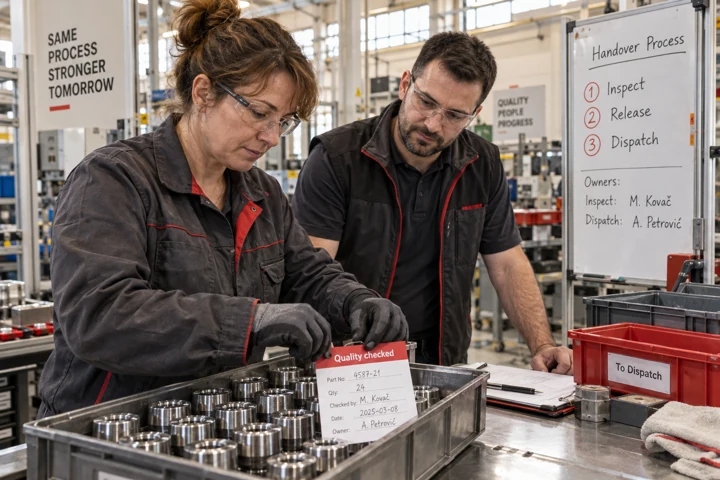
Companies often think documentation is solved when they know where files are stored. That is not enough. A document without an owner quickly becomes unclear. Nobody knows whether it is current, who may change it and whether it is still used.
A useful model gives every important area an owner: sales procedures, support documents, HR materials, security rules, technical documentation, contract templates and service instructions. The owner does not need to write everything, but must be responsible for accuracy and priority.
Only then does documentation for automation become useful. Automation cannot follow a process nobody owns. AI cannot answer reliably from content nobody verifies.
Structure matters more than volume
More documents do not mean better readiness. A smaller set of organised sources is often more valuable than a large archive where valid and invalid content is mixed. First organise the core knowledge, then expand.
The structure should follow how the company works. If the goal is an AI assistant for customer support, the structure should follow questions, procedures, complaints, timelines, escalations and exceptions. If the goal is a service assistant, the structure should follow equipment, contracts, SLA, manuals and procedures.
An AI assistant for documents is useful when it understands the context of a question. This depends not only on the model, but also on how well documents are grouped, described and maintained.
Access rights must be clear before search
One dangerous mistake is to introduce internal knowledge search without access control. Not every piece of information is for everyone. Finance data, contracts, HR documents, legal materials and confidential client data must be protected.
Before AI search is introduced, the company must define who can access which category of knowledge. This is not only a technical permission. It is a business rule that must be reflected in the system.
Secure internal document search must follow the same logic as the business: employees get answers only from sources they are allowed to access. In that case, AI strengthens control instead of weakening it.
The minimum preparation before the first assistant
The practical minimum is clear: choose one area, list relevant documents, mark valid versions, remove obviously outdated content, define the owner, set access rights and prepare test questions.
Test questions should be real questions from employees, not easy demo questions. What do customers ask? What does service search for? What does sales fail to find quickly? If the assistant helps with those questions, the project has business value.
Positive does not start from the idea that all documentation must be perfect. The better path is to select the area with the highest impact, create a good enough foundation and improve the system through use.
How to choose the documentation sequence
The most common mistake is trying to clean the entire archive at once. It sounds thorough, but it often becomes too slow. A better approach is to organise documentation by business value: first the sources that are used most often, affect customers most or create the highest risk if inaccurate.
For customer support, priorities may be frequent questions, complaint rules, timelines and escalation procedures. For service teams, priorities may be contracts, SLA, technical manuals and safety procedures. For sales, priorities may be offers, references, terms and common objections.
This sequence helps the project show value quickly. Instead of cleaning everything for months, one area becomes ready for testing. The company then learns what people really ask, which documents are missing, where access rights are unclear and what should change before expansion.
What should not be added at the beginning
At the beginning, not everything should be added. Archive material, outdated versions, drafts, private notes, unapproved presentations and ownerless documents can create more harm than value. If AI receives too much unverified content, users quickly lose trust.
A smaller verified source set is better. It should be broad enough to answer real questions, but controlled enough to show where each answer comes from. New sources should be added only through a clear rule: who approves them, who maintains them and who may use them.
This protects both quality and security. An AI project should not be a mass upload of files. It should be a disciplined process of turning knowledge into a usable business layer.
Questions management usually asks
Does documentation need to be perfect before an AI project?
No. But it must be clear enough: valid sources, owners, access rights and test questions must be defined.
What should be organised first?
Separate official knowledge from working versions and assign content ownership for each important area.
Can AI identify outdated content by itself?
Not reliably. AI can help analyse content, but the business must confirm what is valid.
Who should participate in documentation preparation?
Process owners, real users, IT, security and the team implementing the AI solution.
How do we know documentation is ready?
When the system can answer real employee questions from verified sources while respecting access rights.
Related services: digital transformation