In this article15 sections
Technology should not choose priorities for management
Before investing in software, AI, infrastructure or automation, a company must understand its critical business processes. These are processes whose delay, failure or poor quality directly affects revenue, customers, costs, risk or reputation. If they are not assessed before technology decisions, there is a high chance that the company will digitalize what is loudest, not what is most important.
This is a common mistake. A company feels pressure, sees that something is not working and quickly concludes that it needs a new tool. Sometimes that is true, but often the tool only accelerates existing chaos. If the process has no owner, data is unreliable, decisions are made verbally and nobody knows where the bottleneck appears, new technology will not solve the problem. It will only make it more expensive and more visible.
Serious digital transformation does not begin with tool selection. It begins with process assessment, risk assessment and prioritization. Technology comes after that, as a means of solving a clearly defined problem.
What makes a process critical
A process is not critical only because it happens often or because people complain about it. Criticality is defined by business impact. If the process stops, what happens to revenue, delivery, customers, compliance, security or operational cost?
For example, proposal approval can be critical if it slows sales and reduces conversion. Complaint handling can be critical if it affects customer trust. Procurement can be critical if delays affect production. Access to documentation can be critical if employees lose time every day searching for information.
A critical process is one where weakness creates a business consequence, not just inconvenience. Management should therefore look at impact, not only visibility.
Five questions before investing in technology
Before deciding on technology investment, it is useful to ask five questions.
- What happens if this process stops for one day?
- How many people, departments or customers depend on it?
- How much manual work, waiting and retyping exists in the process?
- Which data is required for the process to work correctly?
- Who owns the process and decides when something goes wrong?
If there are no clear answers, the process is not ready for serious automation. That does not mean it should be ignored. It means the foundation should be prepared first.
Map processes before mapping tools
Many companies know which tools they use, but not how work actually moves through the organization. Information starts in sales, moves to operations, passes through finance, returns to support and partly disappears in email or chat. On paper everything looks simple. In practice there are gaps.
This is why a process map is more important than a tool list. It shows where work begins, who takes over, where waiting happens, where data is entered, where errors appear and where management loses visibility. Only then can the company decide whether it needs CRM, ticketing, BI, automation, an AI assistant, better documentation or more stable IT infrastructure.
Without a process map, technology is selected based on impression. With a process map, technology is selected based on the problem.
Not every process should be digitalized immediately
Another mistake is trying to digitalize everything at once. It sounds ambitious, but it often creates loss of focus. A better approach is to choose processes with high business impact, a clear problem and realistic readiness for change.
A process that is important but completely unstructured may first require standardization. A frequent process with low business risk may not be the first priority. A process with a lot of manual work and clear data may be an excellent candidate for business automation.
Priority is not simply the biggest pain. It is a combination of business impact, feasibility, team readiness and expected effect.
Process ownership matters more than tool ownership
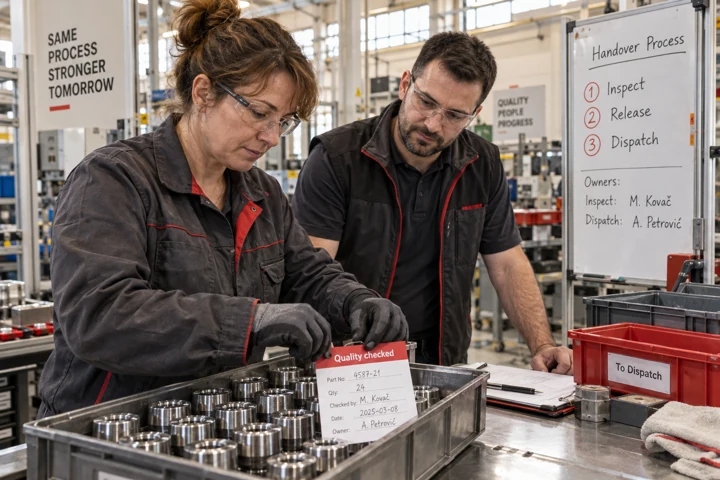
Every critical process needs an owner. This is not the person who performs every task, but the person who understands the goal, measures outcomes, decides on changes and takes responsibility when the process does not work.
Without a process owner, tool implementation often gets stuck. IT can configure the system and consultants can propose a solution, but no one from the business decides how work should be done. Requirements change, projects slow down and people continue working the old way.
This is why ownership assessment is part of process assessment. If a process has no owner, the first task is not software. The first task is organizational clarity.
Data shows process maturity
A process without reliable data is difficult to automate. If the company does not know how long it takes, where errors appear, how many requests arrive or how often work is returned for correction, decisions are based on assumptions.
This does not mean that data must be perfect before the first step. But the company must know which data matters and how it will be collected. Otherwise, the digital project will not have a clear measure of success.
A good candidate for digitalization has at least basic measurability: duration, number of steps, number of participants, number of errors, number of requests, cost or customer impact. If this does not exist, measurement should be defined first.
A practical prioritization matrix
A simple starting point is to evaluate each important process through five criteria:
- business impact
- risk if the process stops
- amount of manual work
- quality and availability of data
- readiness of the process owner and team
Processes with high impact, significant manual work, reasonably clear data and a committed owner are usually good candidates for the first phase. Important but unstructured processes go into preparation. Low-impact processes stay for later.
This matrix prevents digital transformation from becoming a wish list. It turns it into a sequence of decisions.
Positive perspective: diagnosis before solution
Positive does not start these projects by asking which tool the client wants. We start by asking what the company is trying to improve, where the process gets stuck, what the cost of the problem is and who needs to be involved for change to work.
That is why business consulting, process analysis, digital solutions and infrastructure are connected. Sometimes the answer is software. Sometimes AI. Sometimes better data, better documentation, safer infrastructure or clearer rules of work. Often the answer is a combination of layers.
If you want technology investment to make sense, first assess which processes affect results most and which are ready for change. Only then does technology become an ally instead of another cost.
FAQ
What are critical business processes? They are processes whose delay, failure or poor quality directly affects revenue, customers, cost, risk, reputation or business continuity.
Should a company buy a tool first or analyze the process first? The process should be analyzed first. A tool makes sense only when the problem, process owner and success metrics are clear.
How do you choose which process goes first? Evaluate business impact, risk, amount of manual work, data quality and team readiness for change.
What if the process is not structured? It should not be automated immediately. First define rules, ownership, data and basic success measures.
How can Positive help? Positive helps through process diagnosis, priority mapping and selection of the most reasonable technology solution: software, AI, infrastructure, automation or a combination of layers.
Related services: business process optimization